Florida’s lemon law, the Motor Vehicle Warranty Enforcement Act (Fla. Stat. ch. 681), covers a new car, a truck of 10,000 pounds gross vehicle weight or less, or a motor home apart from its living quarters, sold in Florida (bought or leased), for a defect first reported in the first 24 months after delivery. The law presumes the maker has had enough chances if the same defect has been repaired three times and survives a final repair attempt the owner asks for by registered or express mail, or if the vehicle has been out of service 30 or more calendar days (60 for a motor home). Each rule below carries its section, read in the official 2026 Florida Statutes on 11 November 2026; other states are in our state-by-state lemon law guides.
Before an owner can sue, the dispute goes to the Attorney General’s office and, if found eligible, to the Florida New Motor Vehicle Arbitration Board (681.1095(4)). Where the maker has a state-certified program and told the owner in writing how to file, the refund-or-replacement rule applies only once the owner has used that program first (681.108(1)), and motor homes go to their own mediation and arbitration program (681.1097(1)).
This page is general information, not legal advice and not a substitute for the advice of an attorney. Lemon laws, deadlines and required steps vary by state and change. The statute, the maker, a state board or a court decides a claim.
Florida in four numbers
- 24 months from original delivery: the “Lemon Law rights period”, no mileage limit (681.102(9)).
- 3 repairs plus a final attempt on the same defect, after written notice by registered or express mail (681.104(1)(a), (3)(a)).
- 30 calendar days out of service for repairs, cumulative, 60 for a motor home, with a written notice at 15 days (681.104(1)(b), (3)(b); “days” means calendar days, 681.102(5)).
- Miles x base price / 120,000: the use offset taken off a refund (60,000 for a motor home), counting miles up to a settlement or the arbitration hearing, whichever comes first (681.102(19)).
Source: Fla. Stat. ch. 681, The 2026 Florida Statutes, read 11 November 2026.
The coverage window: 24 months
The statute calls it the “Lemon Law rights period”: “the period ending 24 months after the date of the original delivery of a motor vehicle to a consumer” (681.102(9)). There is no mileage limit in the definition.
What has to happen inside the 24 months is the first report. If the car “does not conform to the warranty and the consumer first reports the problem to the manufacturer or its authorized service agent during the Lemon Law rights period”, the maker or its dealer must make the repairs “irrespective of whether such repairs are made after the expiration” of the period, and at no cost while the maker’s written warranty runs (681.103(1)). The same subsection adds that this does not extend the rights period or the time to file a claim. The presumption below counts only what happens “during the Lemon Law rights period” (681.104(3)).
A “nonconformity” is “a defect or condition that substantially impairs the use, value, or safety of a motor vehicle”. It does not include one that results from “an accident, abuse, neglect, modification, or alteration” by anyone other than the maker or its authorized service agent (681.102(15)).
The presumption: 3 repairs or 30 days
Florida’s law asks whether the maker could not fix the defect “after a reasonable number of attempts” (681.104(2)(a)). Section 681.104(3) says that number is presumed if, during the rights period, either of two things happened:
“(a) The same nonconformity has been subject to repair at least three times by the manufacturer or its authorized service agent, plus a final attempt by the manufacturer to repair the motor vehicle if undertaken as provided for in paragraph (1)(a), and such nonconformity continues to exist; or
(b) The motor vehicle has been out of service by reason of repair of one or more nonconformities by the manufacturer, or its authorized service agent, for a cumulative total of 30 or more days, 60 or more days in the case of a recreational vehicle, exclusive of downtime for routine maintenance prescribed by the owner’s manual.”
Fla. Stat. 681.104(3), The 2026 Florida Statutes, read 11 November 2026
- Repairs: three repairs of the same defect, plus the final attempt described in the next section, and the defect is still there. There is no separate, shorter count for a safety defect in Florida, as some states have; safety is part of the definition of a nonconformity.
- Days: 30 or more cumulative days out of service for repair of one or more defects (they need not be the same defect), 60 for a motor home, not counting routine maintenance. “Days” means calendar days (681.102(5)). The maker must have had “at least one opportunity to inspect or repair the vehicle” after the 15-day written notice described below (681.104(3)(b)).
- Extensions: the 30-day or 60-day period “may be extended” for time when repair services are not available because of “war, invasion, strike, fire, flood, or natural disaster” (681.104(3)(b)).
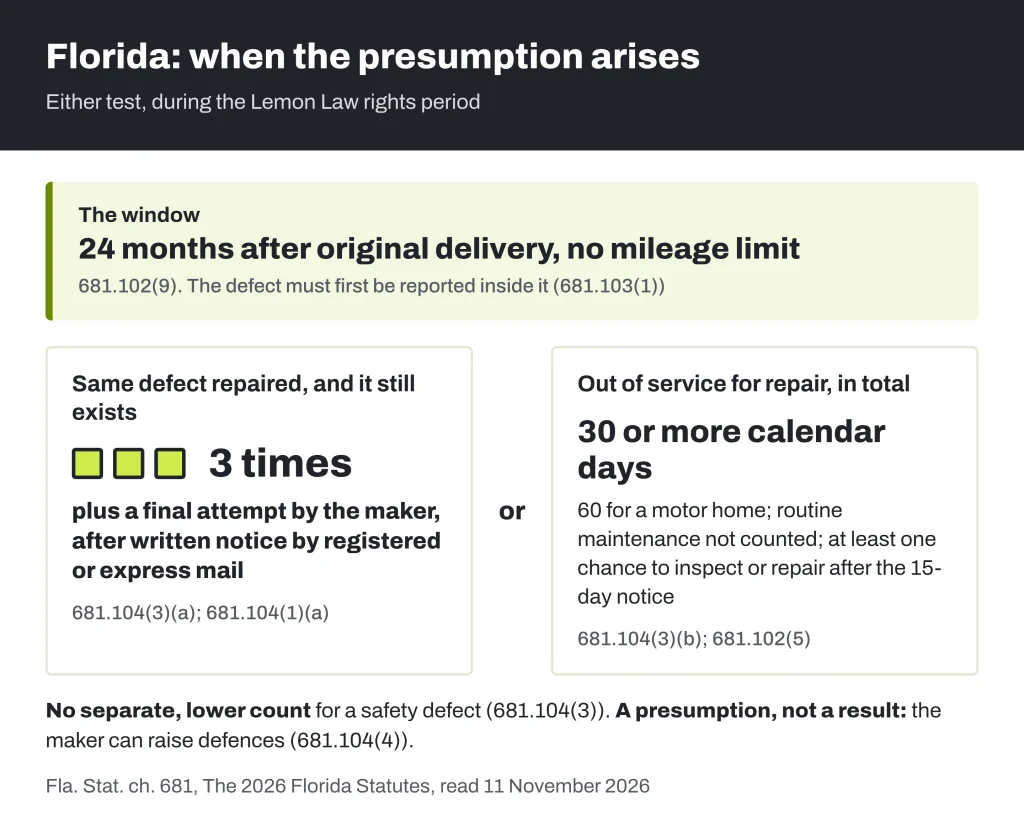
A presumption is a starting point in law, not a result. The maker can raise defences: that the defect does not substantially impair use, value or safety; that it comes from an accident, abuse, neglect or unauthorised changes; or that the claim “was not filed in good faith”, plus “any other affirmative defense allowed by law” (681.104(4)). Our lemon law checker compares your own counts with Florida’s numbers and lists what it can’t check.
Steps that come first: notice, program, board
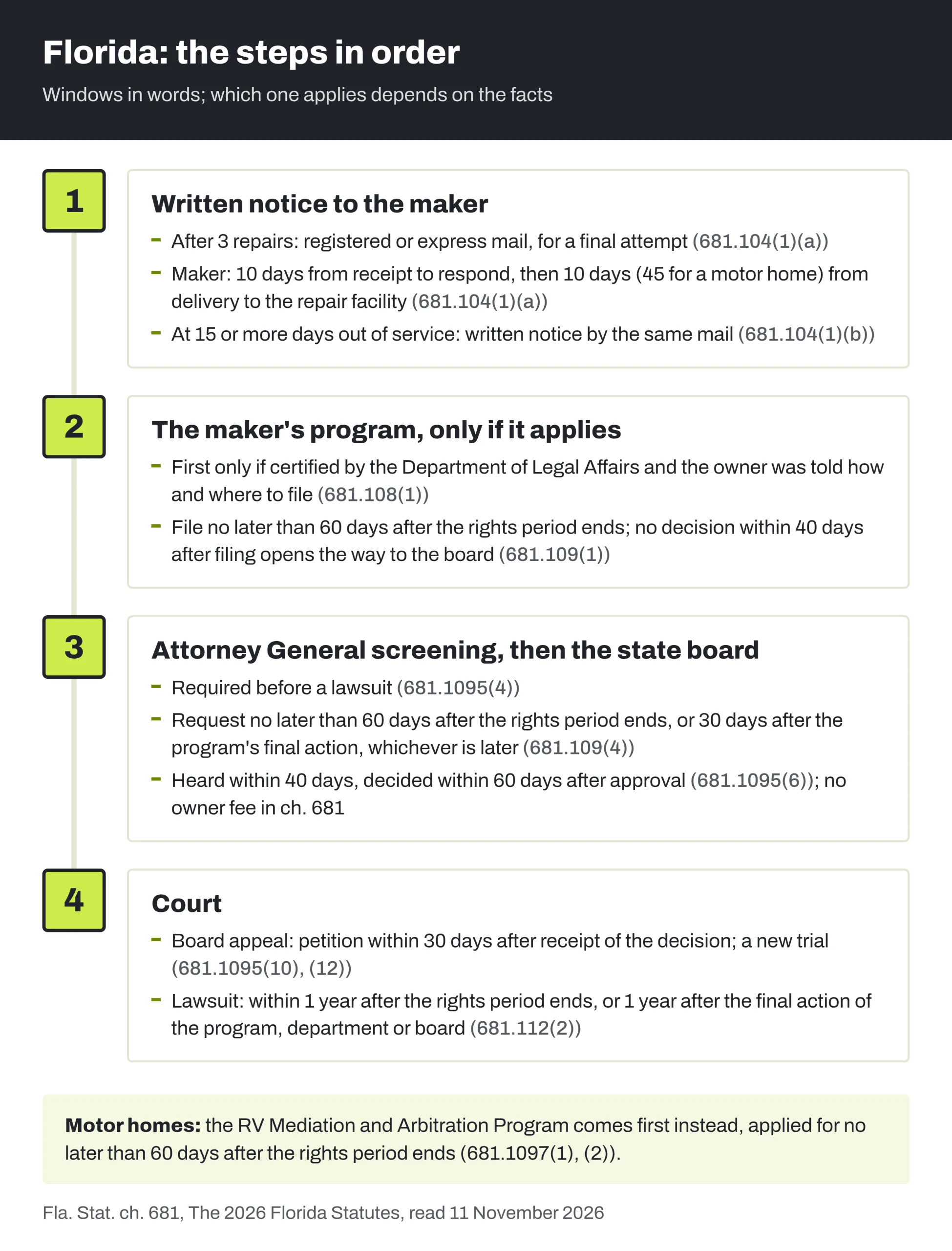
Florida puts several steps before a lawsuit. In the order the statute sets them:
1. Written notice to the maker
- After three repair attempts: “the consumer shall give written notification, by registered or express mail to the manufacturer, of the need to repair the nonconformity to allow the manufacturer a final attempt to cure” (681.104(1)(a)). Notice goes to the maker, not the dealer.
- The maker’s two 10-day periods: it has 10 days “commencing upon receipt” of the notice to respond and offer a repair at “a reasonably accessible repair facility”; then 10 days (45 for a motor home) “commencing upon the delivery of the motor vehicle to the designated repair facility” to fix it (681.104(1)(a)). The two periods start at different moments.
- If the maker doesn’t respond or repair in time, “the requirement that the manufacturer be given a final attempt to cure the nonconformity does not apply” (681.104(1)(a)).
- After 15 days out of service: once the car has been out of service for repair “for a cumulative total of 15 or more days”, the owner “shall so notify the manufacturer in writing by registered or express mail” so the maker or its agent can inspect or repair it (681.104(1)(b)).
- Where to send it: each maker must print the address and phone number of its zone, district or regional office for Florida in the written warranty or owner’s manual (681.103(2)).
The Attorney General’s office offers an optional Motor Vehicle Defect Notification form for either notice; its instructions say to send it to the maker “by registered or express mail, return receipt requested”, not to the dealer, to keep a copy with the mail receipt, and to send a third copy by regular mail to the Attorney General’s Lemon Law Research Unit; the form “does NOT start arbitration” (read 11 November 2026). For a motor home or conversion van, the same page says a form may have to go to each maker that warrants the affected parts. You may see “certified mail” on other sites, and the Attorney General’s overview page also lists certified mail; the statute’s text says “registered or express mail” in both places, and we give the statute’s words.
2. The maker’s certified program, if it has one
Some makers run an informal dispute program. In Florida it must be used first only if two things are true: the Department of Legal Affairs (the Attorney General’s office) has certified it as substantially complying with the federal rules for such programs, 16 CFR part 703, and the maker “has informed the consumer how and where to file a claim” with it (681.108(1)). The maker must give that information in writing at the time of purchase or lease (681.103(3)). Where both are true, the refund-or-replacement rule in 681.104(2) applies “only if the consumer has first resorted to such procedure” (681.108(1)). Certification lasts a year at most and must be renewed (681.108(2)(b), (5)). The Attorney General publishes the list of makers with state-certified programs; on 11 November 2026 it said certification was “provisionally extended up to April 30, 2027”. The same page warns that using a program that is not state-certified “may cost you valuable time” and lemon law rights.
- A claim arising in the rights period must be filed with the certified program “no later than 60 days after the expiration of the Lemon Law rights period” (681.109(1)).
- If the program gives no decision “within 40 days after filing”, or the owner is not satisfied with the decision or the maker’s compliance, the owner may apply to the department to take the dispute to the state board (681.109(1), (2)). The maker “may not seek review” of its own program’s decision (681.109(2)).
- If the maker has no certified program, or it has no jurisdiction over the dispute, the owner applies directly to the department (681.109(3)).
How these programs work nationally, and what the federal rule requires of them, is on our lemon law arbitration page.
3. The Attorney General’s screening and the state board
“Before filing a civil action on a matter subject to s. 681.104, the consumer must first submit the dispute to the department, and to the board if such dispute is deemed eligible for arbitration” (681.1095(4)). The steps, from the statute:
- Request. The request is “made on a form prescribed by the department” (681.109(5)); the Attorney General posts the Request for Arbitration form. It must come no later than 60 days after the rights period ends, or within 30 days after the final action of a certified program, “whichever date occurs later” (681.109(4)).
- Screening. The department screens every request and forwards those “potentially entitled to relief” (681.109(5)). It may reject one it finds fraudulent, outside the board’s authority or, after a second review, “clearly insufficient”, and must explain why. A rejected owner “may file a lawsuit” (681.109(6), (7)).
- Hearing. The maker must take part once the dispute is found eligible (681.1095(5)). A panel of three board members hears it “within 40 days” and decides “within 60 days after the date the request for arbitration is approved”; a continuance the owner asks for waives those periods (681.1095(2), (6)). Both sides may present evidence and witnesses and “be represented by counsel” (681.1095(7)).
- Decision. The board “shall grant relief, if a reasonable number of attempts have been undertaken” (681.1095(8)). A decision for the owner must be carried out by the maker “within 40 days after receipt” (681.1095(9)).
- Appeal. “A decision is final unless appealed by either party.” A petition to circuit court is due “within 30 days after receipt of the decision”, and the appeal is a new trial (“trial de novo”) (681.1095(10), (12)).
Chapter 681 sets no fee for the owner to use the board. It does have every buyer and lessee pay a $2 fee at the sale or lease, which funds the state’s Motor Vehicle Warranty Trust Fund (681.117(1)). If a maker neither complies with a decision for the owner nor appeals, and the department has not received notice of an appeal within 40 days after the maker received the decision, the department may ask a circuit court for a fine of up to $1,000 a day until it reaches twice the vehicle’s purchase price, unless the maker shows by clear and convincing evidence that the delay was beyond its control or was accepted by the owner in a signed written statement (681.1095(10)).
The remedy and the use offset
If the defect can’t be fixed after a reasonable number of attempts, the maker, “within 40 days, shall repurchase the motor vehicle and refund the full purchase price to the consumer, less a reasonable offset for use”, or replace it with a vehicle “acceptable to the consumer”, with the owner paying the use offset. Either way, the refund or replacement “must include all reasonably incurred collateral and incidental charges”. And “the consumer has an unconditional right to choose a refund rather than a replacement motor vehicle” (681.104(2)(a)).
What the refund counts
- Purchase price: the cash price, “inclusive of any allowance for a trade-in vehicle, but excludes debt from any other transaction”. If owner and maker don’t accept the contract’s trade-in figure, the trade-in counts at 100% of its retail price in the NADA Official Used Car Guide (Southeastern Edition), or the NADA RV guide, at the time of the trade (681.102(18)).
- Collateral charges: charges “wholly incurred as a result of the acquisition”, including “manufacturer-installed or agent-installed items or service charges, earned finance charges, sales taxes, and title charges” (681.102(3)).
- Incidental charges: “reasonable costs to the consumer which are directly caused by the nonconformity” (681.102(7)).
- Replacement: “identical or reasonably equivalent”, meaning a sticker price (MSRP) no more than 105% of the original’s; for a motor home, a retail price no more than 105% of the original purchase price (681.102(21)).
- Who is paid: the owner and any lienholder “as their interests may appear” (681.104(2)(b)). The owner then hands over clear title and possession (681.104(2)(a)).
The use offset, worked
“‘Reasonable offset for use’ means the number of miles attributable to a consumer up to the date of a settlement agreement or arbitration hearing, whichever occurs first, multiplied by the base selling or sale price of the vehicle as reflected on the purchase invoice, exclusive of taxes, government fees, and dealer fees, or in the case of a lease, the agreed-upon value as reflected in the lease agreement and divided by 120,000, except in the case of a recreational vehicle, in which event it shall be divided by 60,000.”
Fla. Stat. 681.102(19), The 2026 Florida Statutes, read 11 November 2026
So: offset = miles attributable to the owner, up to the settlement or the hearing, whichever comes first, x base selling price (no taxes, government fees or dealer fees) / 120,000. Two things stand out. The miles run to the settlement or hearing date, not to the first repair visit as in some other states’ formulas, so the offset keeps growing while a dispute goes on. And the price in the formula is the base price only, while the refund itself includes taxes, title and other collateral charges.
| Example (hypothetical) | Base price | Owner’s miles to hearing | Divisor | Offset |
|---|---|---|---|---|
| Car | $38,000 | 15,000 | 120,000 | $4,750.00 |
| Motor home | $150,000 | 6,000 | 60,000 | $15,000.00 |
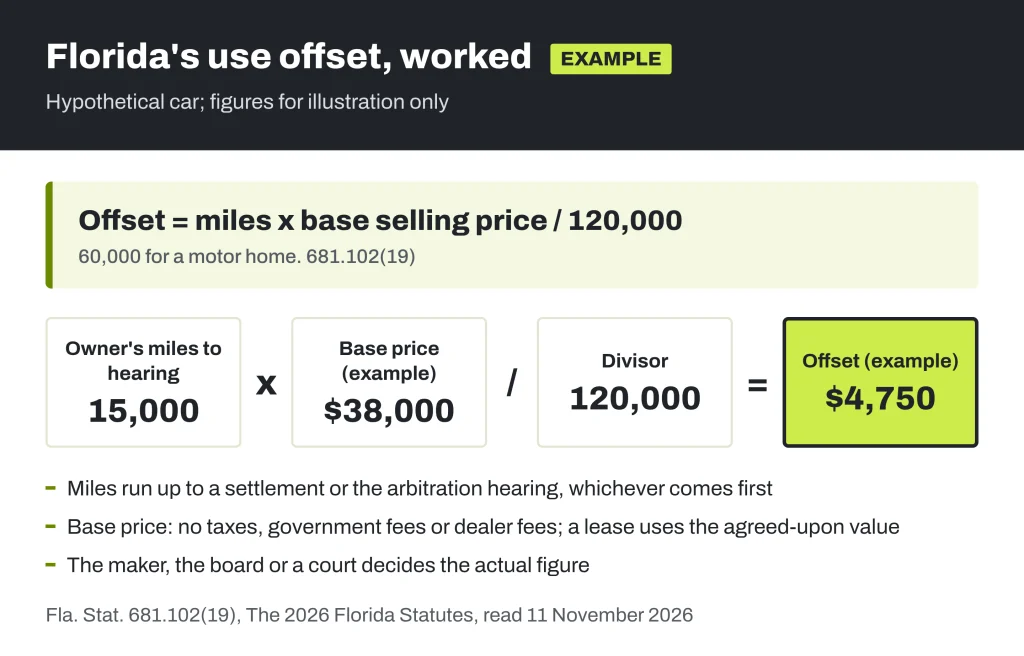
Our buyback and refund estimator runs this formula on your own figures, with Florida selected, and shows its working. It gives an estimate only.
Who and what is covered
- Vehicles: “a new vehicle … which is sold in this state to transport persons or property”, including a recreational vehicle, a demonstrator and a leased vehicle “if a manufacturer’s warranty was issued as a condition of sale, or the lessee is responsible for repairs” (681.102(14)).
- Not covered: “vehicles run only upon tracks, off-road vehicles, trucks over 10,000 pounds gross vehicle weight, motorcycles, mopeds, electric bicycles, or the living facilities of recreational vehicles” (681.102(14)).
- Motor homes: a “recreational vehicle” provides “temporary living quarters”; a van conversion is not one (681.102(20)). The living facilities are excluded: flooring, plumbing and fixtures, roof air conditioner, furnace, generator, electrical systems other than automotive circuits, the side entrance door, exterior compartments, and windows “other than the windshield and driver and front passenger windows” (681.102(14)).
- Personal use: a “consumer” is a buyer, other than for resale, or lessee “of a motor vehicle primarily used for personal, family, or household purposes” (681.102(4)). The chapter sets no fleet-size rule and no separate business-use rule; a vehicle not primarily used for those purposes is outside the definition’s words.
- Second owners: the definition also covers “any person to whom such motor vehicle is transferred for the same purposes during the duration of the Lemon Law rights period” and anyone entitled to enforce the warranty (681.102(4)); “the rights set forth in this chapter shall extend to a subsequent transferee” (681.115).
- Leases: a “lessee” leases “for 1 year or more” under a written lease that makes the lessee responsible for repairs, or under a lease-purchase agreement (681.102(10)). On a refund, “the lessee shall receive the lessee cost” (deposits and rental payments paid) “and the lessor shall receive the lease price less the lessee cost”, and no early-termination penalty may be charged (681.104(2)(b); 681.102(8), (11)). The offset uses “the agreed-upon value as reflected in the lease agreement” (681.102(19)). More on leased cars and lemon laws.
- Waivers: any agreement that “waives, limits, or disclaims” these rights, or requires the owner to keep its terms secret as a condition, “is void as contrary to public policy” (681.115).
- Dealers: the claim runs against the maker. Apart from the dealer’s duties under 681.103(3) and 681.114(2), the chapter imposes no liability on a dealer except for the dealer’s own written express warranties made apart from the maker’s, and a dealer “may not be made a party defendant” except as the section provides (681.113).
The deadline to act, as a rule
Florida has several windows, each measured from the end of the 24-month rights period or from a program’s or the board’s final step. In words:
- Maker’s certified program: file no later than 60 days after the rights period ends (681.109(1)).
- State board: request no later than 60 days after the rights period ends, or within 30 days after a certified program’s final action, whichever is later (681.109(4)).
- Motor home program: apply no later than 60 days after the rights period ends (681.1097(2)).
- Board appeal: petition the circuit court within 30 days after receiving the decision (681.1095(10)).
- Lawsuit: “within 1 year after the expiration of the Lemon Law rights period, or, if a consumer resorts to an informal dispute-settlement procedure or submits a dispute to the department or board, within 1 year after the final action of the procedure, department, or board” (681.112(2)).
Chapter 681 has no separate tolling clause. What moves the one-year lawsuit window is the second trigger in 681.112(2): once an owner uses a maker’s procedure, the department or the board, the year runs from that body’s final action. Other laws may set their own limits, which we have not read for this page. We don’t compute a date: which window applies depends on facts only the owner, the maker, the department or a court can settle, and an earlier date may apply. Our deadline rule lookup shows Florida’s rules in these words.
Motor homes use their own program
For motor homes acquired on or after 1 October 1997 (681.1096(1)), the path is different. The owner “must first submit the dispute to the program” (the RV Mediation and Arbitration Program) before suing, and does not have to use a maker’s certified program or the state board, except where the program isn’t qualified for a maker (681.1097(1); 681.1096(4)). Every maker involved, including chassis and component makers that warrant their parts separately, must take part (681.1096(2)). No program fees may be charged to the owner (681.1096(3)(b)). Mediation comes first and is mandatory for both sides; if it reaches an impasse, a single arbitrator hears the case, and the whole process is to be completed within 70 days of the program receiving the claim (681.1097(4), (5); 681.1096(3)(k)). The arbitrator’s decision is binding unless appealed the same way as a board decision (681.1097(7)).
Attorney fees and costs
- Court: “The court shall award a consumer who prevails in such action the amount of any pecuniary loss, litigation costs, reasonable attorney’s fees, and appropriate equitable relief” (681.112(1)). The text says “shall” for an owner who prevails; it gives no fee award to an owner who loses.
- A board award upheld in court: the owner’s recovery includes the award, “attorney’s fees incurred in obtaining confirmation of the award”, costs, and $25 a day for each day beyond the maker’s 40-day compliance period. If the court finds the maker appealed in bad faith or only to harass, it “shall double, and may triple” the award (681.1095(13)).
- Bad-faith claims by an owner: a claim “found by the court to have been filed in bad faith or solely for the purpose of harassment, or in complete absence of a justiciable issue” makes the owner liable for the maker’s “costs and reasonable attorney’s fees” (681.106).
You may see “the lawyer is free, the maker pays” on other sites. Florida’s text awards fees to an owner who prevails, and can put the maker’s fees on an owner whose claim a court finds was brought in bad faith; it promises nothing about a claim that loses. How lemon lawyers are paid, state by state, is on our lemon law lawyer fees page. The Florida Bar runs its own Lawyer Referral Service; its page says local bar associations run nine referral services in Florida’s major cities and the Bar handles referrals from the other areas (the Bar’s page, read 11 November 2026 in the Internet Archive’s copy of 25 October 2026, because the live page refused our reader).
Used cars and buyback cars in Florida
Chapter 681 covers new vehicles. It has no separate used-car rule; a later owner is covered as a person to whom the vehicle is transferred for personal, family or household use during the original 24 months, or as a person entitled by the warranty’s terms to enforce it, as above (681.102(4), (14); 681.115). For other used cars, the federal rules apply: the FTC’s Buyers Guide window sticker says whether a dealer sells “as is” or with a warranty (16 CFR part 455, eCFR, read 11 November 2026), and a seller that gives a written warranty, or enters into a service contract with the buyer at the sale “or within 90 days thereafter”, may not disclaim implied warranties (15 U.S.C. 2308(a), US Code 2024 edition, read 11 November 2026). Both are explained on our used car Buyers Guide page.
Cars that a maker took back under Florida’s law, or a similar law in another state, may not be knowingly sold, leased or transferred “unless the nature of the nonconformity is clearly and conspicuously disclosed” and the maker warrants to correct it “for a term of 1 year or 12,000 miles, whichever occurs first” (681.114(2)). The maker reports each returned vehicle’s identification number to the department “within 10 days after such acceptance, transfer, or disposal of the vehicle, whichever occurs later” (681.114(1)).
What to keep, and where to start
- Every repair order. Each time the car comes back from a warranty repair, the maker’s dealer must give “a fully itemized, legible statement or repair order” showing the problem reported, any diagnosis and test drive, the work done, parts and labor, the date and odometer reading when it went in, and the date the work was finished (681.103(4)). These dates and readings are what the 30-day count and the offset are built from.
- Copies of each notice sent to the maker, with the registered or express mail receipt, and the maker’s reply.
- The papers from the sale or lease: the purchase invoice (it shows the base selling price), the lease agreement, and the written statement of rights and any certified-program information the dealer and maker must give at acquisition (681.103(3)).
- Receipts for costs caused by the defect, such as towing or a rental, which may count as incidental charges (681.102(7)).
The Attorney General’s Lemon Law page is at myfloridalegal.com. It explains the process and gives the Lemon Law Hotline, 1-800-321-5366 (850-414-3500 from outside Florida), which can also say whether a maker has a state-certified program (read 11 November 2026). The full statute is on the Florida Legislature’s Online Sunshine site. Florida’s row, with every other state’s, is in our lemon laws in all 50 states and DC table.
Chapter 681 also leaves other remedies open: it “does not prohibit a consumer from pursuing other rights or remedies under any other law” (681.112(3)), which includes the federal Magnuson-Moss Warranty Act.
Fact-check note. Statutes and rules checked on 11 November 2026: Fla. Stat. 681.10 to 681.118 read in full in The 2026 Florida Statutes on the Florida Legislature’s Online Sunshine site, including the 2023 amendment (ch. 2023-233, ss. 7-8), which changed cross-references and wording in 681.102(13) and 681.113, not the owner’s rights. The Attorney General’s Lemon Law pages (overview, certified-program list, defect notification instructions, request form page) were read the same day. The Florida Bar’s referral page refused our reader, so it was read in the Internet Archive’s copy of 25 October 2026. The federal points rest on 16 CFR 455 and 15 U.S.C. 2308(a), as cited. We recheck Florida’s rules every three months and after each legislative session.
Sources
- Fla. Stat. ch. 681 (681.10-681.118), Motor Vehicle Warranty Enforcement Act, The 2026 Florida Statutes
- Florida Attorney General: How the Florida Lemon Law Works
- Florida Attorney General: State-Certified, Manufacturer-Sponsored Programs
- Florida Attorney General: How to Use the Motor Vehicle Defect Notification Form
- Florida Attorney General: Lemon Law Request for Arbitration Forms
- 15 U.S.C. 2308, Implied warranties (US Code, 2024 edition, govinfo)
- 16 CFR part 455, Used Motor Vehicle Trade Regulation Rule (eCFR)