
Yes, some used cars are covered, but only in some states, and usually only when you buy from a dealer (more in our used cars and dealers guide). In the statutes we read on 11 November 2026, twelve states have a law written for used cars sold by dealers: Arizona, Connecticut, Hawaii, Illinois, Maine, Massachusetts, Minnesota, New Jersey, New Mexico, New York, Rhode Island and West Virginia. The District of Columbia adds a duty to disclose known defects. These laws differ a lot. Some make the dealer give a written warranty for a set number of days or miles and refund the price after repeated failed repairs. Others give a short implied warranty of 15 days or 500 miles, or limit “as is” sales. We have not yet read every state’s general consumer laws, so other states may add rules of their own. Three federal rules also apply: the Buyers Guide, a limit on “as is” sales when the dealer enters into a service contract with you within 90 days, and the maker’s warranty if it is still running.
This page is general information, not legal advice and not a substitute for the advice of an attorney. Lemon laws, deadlines and required steps vary by state and change. The statute, the maker, a state board or a court decides a claim.
Three kinds of used-car rule
- A dealer warranty the law requires, with a refund or buyback after repeated failed repairs: New York, New Jersey, Massachusetts, Rhode Island, Hawaii and Minnesota (in Minnesota the refund is at the dealer’s election). Connecticut also requires a dealer warranty, but its chapter sets no buyback.
- A short implied warranty the dealer can’t disclaim: 15 days or 500 miles, whichever comes first, in Arizona, Illinois and New Mexico. In Maine, the dealer warrants that the car meets the state inspection standards.
- Limits on “as is” sales or a disclosure duty: West Virginia lets dealers sell “as is” only in set cases (under $4,000, more than 100,000 miles, or seven years old or older, among others). The District of Columbia requires written notice of known defects.
Each rule is cited below by section, read in the official text on 11 November 2026.
Is a used-car law a “lemon law”?
A new-car lemon law makes the maker repair a defect under its warranty and, after a set number of failed repairs or days in the shop, buy the car back or replace it. Used-car laws mostly work on the selling dealer instead of the maker. They set a minimum warranty, or stop the dealer from selling “as is” (with no warranty, express or implied, so the buyer pays for every repair). New York’s law calls the notice dealers must hand over the “Used Car Lemon Law Bill of Rights” (GBL 198-b(f)(1), (g)).
Some words you’ll see below. An express warranty is a written promise, here one the statute makes the dealer give. An implied warranty of merchantability is the promise the law reads into a sale: the goods are fit for their ordinary purpose, which for a car means ordinary driving. A presumption is the point at which the statute treats the dealer as having had enough chances to repair. The offset, or allowance for use, is the amount taken off a refund for the miles you drove.
The states at a glance
This table is a summary. Each state’s fold-out below gives the exclusions, the repair and refund rules, and the time to sue as written in its statute. “Dealer” means the seller the statute names. Most set a minimum number of used-car sales in the past 12 months, so a private sale is usually outside these laws.
| State | What the law gives | How long | Statute |
|---|---|---|---|
| Arizona | Implied warranty the dealer can’t disclaim; buyer pays half of the first 2 repairs, up to $25 each | 15 days or 500 mi | ARS 44-1267 |
| Connecticut | Dealer warranty, parts and labor, at $3,000 or more; no disclaimer of implied warranties | 30 days/1,500 mi or 60 days/3,000 mi, by price | CGS 42-221 |
| DC | Written notice of known defects and damage over $1,000 | Before sale | DC Code 50-505 |
| Hawaii | Dealer warranty; refund after 3 attempts or more than 10 business days out | 30 to 90 days, by mileage | HRS 481J |
| Illinois | Powertrain implied warranty; buyer pays half of the first 2 repairs, up to $100 each | 15 days or 500 mi | 815 ILCS 505/2L |
| Maine | Dealer warrants the car meets state inspection standards; can’t be waived | No period stated | 10 MRSA 1474 |
| Massachusetts | Dealer warranty; buyback after 3 attempts or more than 10 business days out | 30 to 90 days, by mileage | MGL c. 90, s. 7N1/4 |
| Minnesota | Dealer warranty on listed parts; repair, or refund at the dealer’s election | 15 to 60 days, by mileage | Minn. Stat. 325F.662 |
| New Jersey | Dealer warranty on powertrain parts; repurchase after 3 repairs or 20 days out | 30 to 90 days, by mileage | NJSA 56:8-67 to -80 |
| New Mexico | Implied warranty the dealer can’t disclaim; buyer pays half of the first 2 repairs, up to $25 each | 15 days or 500 mi | NMSA 57-16A-3.1 |
| New York | Dealer warranty; refund after 3 repairs or 15 days out | 30 to 90 days, by mileage | GBL 198-b |
| Rhode Island | Dealer warranty; refund after 3 repairs or 15 days out; “as is” allowed with a posted notice | 30 or 60 days, by mileage | RIGL 31-5.4 |
| West Virginia | “As is” only in listed cases, then a 3-business-day cancel right | Implied warranties otherwise | WV Code 46A-6-107a |
State by state: the details
Open a state to see who is covered, what’s excluded, how a repair or refund works, and the time limit the statute sets. Where the statute says nothing on a point, we say so. A general limit may then apply, which we have not read.
Arizona: 15 days or 500 miles, implied warranty
- Who it binds: a “used motor vehicle dealer”, one that sold or offered four or more used vehicles in the previous 12 months. Banks, insurers, employer-to-employee and lessor-to-lessee sales, and classic and historic car traders are not dealers (ARS 44-1261(A)(4)). The article doesn’t apply to vehicles over 10,000 pounds declared gross weight, sales at public auction, or sales for resale (44-1261(C)).
- The rule: the dealer can’t exclude, modify or disclaim the implied warranty of merchantability “before midnight of the fifteenth calendar day after delivery” or until the car is driven 500 miles after delivery, whichever is earlier. Days when the car is in breach, and miles driven for its repair, don’t count (44-1267(B)). The warranty is met if the car “functions in a safe condition” and is “substantially free of any defect that significantly limits” its use for ordinary transportation (44-1267(C)).
- Repairs: the buyer gives “reasonable notice” and the seller gets “a reasonable opportunity to repair”. The buyer pays half of the first two repairs, at most $25 each (44-1267(E)). The seller’s liability is capped at the purchase price (44-1267(F)). Damage from abuse, neglect, missed maintenance, off-road use, racing or towing isn’t covered (44-1267(D)).
- Waiver: only for a particular defect the dealer disclosed, with a signed statement on the first page of the sales agreement. The dealer must prove it complied (44-1267(I), (J)).
- Time to sue: the section sends both sides to the remedies in Arizona’s UCC, title 47, chapter 2 (44-1267(K)), and sets no period of its own. The article it sits in also says a consumer “shall begin an action under this article within six months” after the earlier of the end of the express warranty term or two years or 24,000 miles from original delivery to the consumer (44-1265(B)). That rule is written around the new-car warranty; whether it reaches a used-car claim is for a court. An earlier date may apply.
- Official text: ARS 44-1267 and 44-1261 and 44-1265, Arizona Legislature, read 11 November 2026 (no “current through” note on the page).
Connecticut: 30 or 60 days, dealer warranty by price
- Who it binds: a licensed new or used car dealer, or a business holding a leasing or rental license under CGS 14-15 that sells used cars to consumers (CGS 42-220(1)). The consumer is the buyer of a car normally used for personal, family or household purposes. A lessee who buys the car at the end of the lease is not a “consumer” (42-220(5)).
- The rule: at a cash purchase price of $3,000 or more, the dealer “shall not exclude, modify, disclaim or limit implied warranties” (42-221(a)). The contract must include an express warranty “covering the full cost of both parts and labor” that the car is “mechanically operational and sound”: 30 days or 1,500 miles from $3,000 to under $5,000, and 60 days or 3,000 miles at $5,000 or more, whichever ends first. Phrases like “fifty-fifty”, “labor only” or “drive train only” can’t limit it (42-221(b)). The cash purchase price includes the trade-in value and excludes the finance charge (42-220(4)).
- Excluded: a cash price under $3,000, dealer-to-dealer sales, and cars seven years old or older, counted from 1 January of the model year (42-221(c)). A dealer may sell a car “as is” only if its cash price is under $3,000 or it is seven years old or older, and only with the boxed disclaimer on the front page, signed inside the box (42-224).
- Repairs: the dealer must honor the warranty after it expires if you notified the dealer of the breach within the warranty period (42-222). The period is extended while the car is with the dealer for warranty repair (42-223(a)). Chapter 743f sets no buyback.
- Time to sue: chapter 743f states no period of its own. A general limit may apply, which we have not read.
- Waiver: only for a particular defect the dealer disclosed, in a signed, conspicuous writing (42-221(d)). Other waivers are voidable at the consumer’s option (42-223(c)).
- Official text: CGS chapter 743f, Connecticut General Assembly, read 11 November 2026. The site points readers to the 2026 Supplement, revised to 1 January 2026, where 42-221 shows a 2025 amendment (P.A. 25-145) and the same warranty terms.
District of Columbia: written notice of known defects
- The rule: a dealer may not offer a used car without first giving written notice of “any material mechanical defect” and any damage from fire, water, collision or other causes that cost more than $1,000 to repair, when the dealer knew of it. The dealer must also say in writing whether it inspected the car for defects or damage (DC Code 50-505(a)).
- Remedy and order of steps: the buyer has a right of action for damages, but “shall first submit a claim to the Board”. The buyer may go to court only if the Board rejects the case for arbitration, or after rejecting the arbitration decision (50-505(c)).
- Not a dealer warranty: DC’s used-car section is a disclosure duty. DC’s general rule against disclaiming implied warranties on consumer goods (DC Code 28:2-316.01) applies as well; see the federal rules section below.
- Official text: DC Code 50-505, Council of the District of Columbia, read 11 November 2026.
Hawaii: 30 to 90 days, dealer warranty and refund
- Who it covers: a buyer for mainly personal, family or household use, and a spouse or child the car passes to during the warranty (HRS 481J-1). A “used motor vehicle” is one bought or transferred after one year from original delivery or after 12,000 miles, whichever occurs first (481J-1).
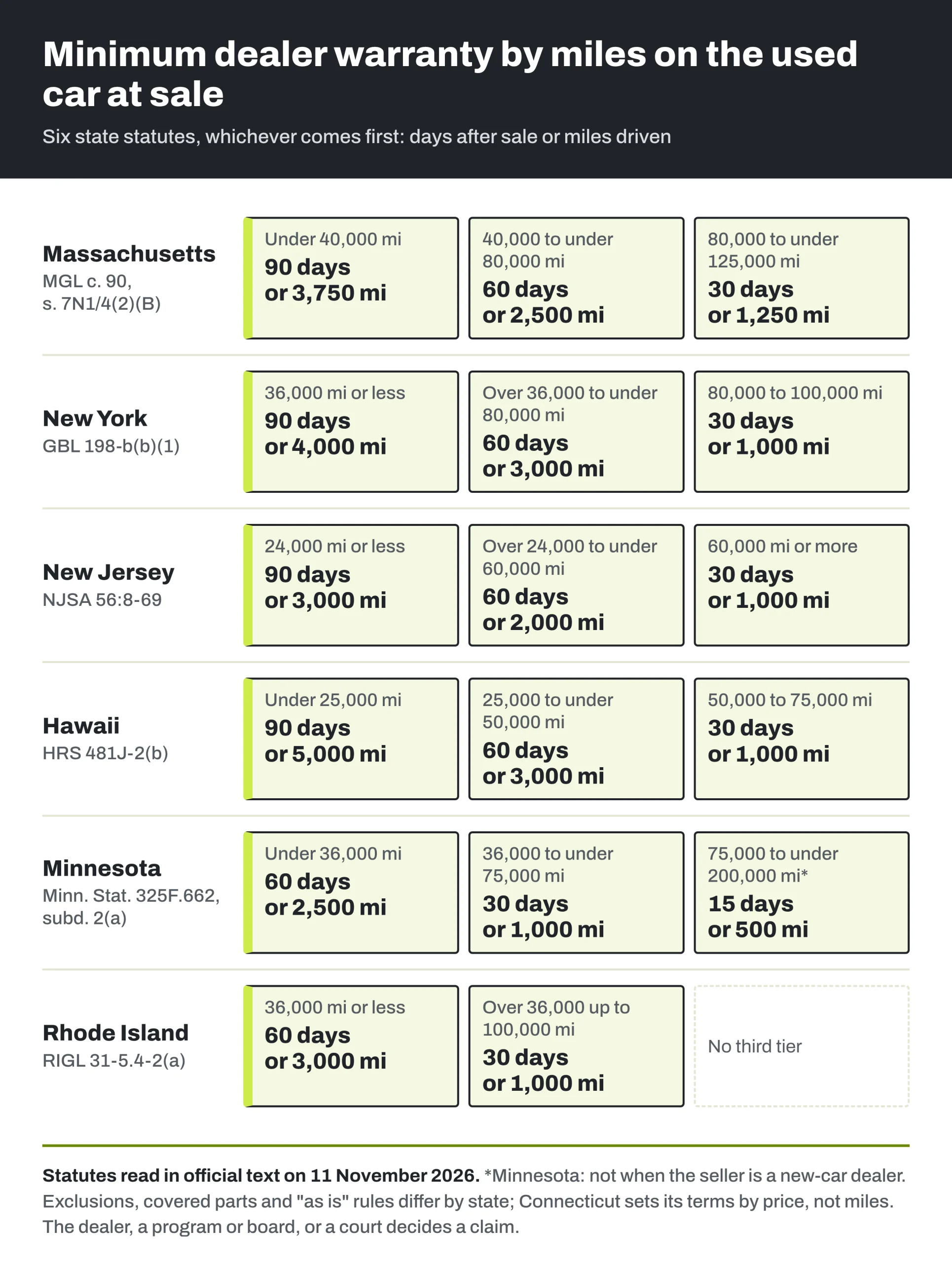
- The rule: a written warranty “covering the full cost of both parts and labor” to repair a defect in a covered part “that impairs the used motor vehicle’s safety or use” (481J-2(a)). Minimum terms, whichever occurs first: under 25,000 miles, 90 days or 5,000 miles; 25,000 to under 50,000, 60 days or 3,000 miles; 50,000 to 75,000, 30 days or 1,000 miles (481J-2(b)). Covered parts include the engine, transmission, drive axle, brakes, radiator, steering, alternator, generator, starter and ignition system, but not the battery. The transmission and drive-axle items exclude four-wheel-drive vehicles (481J-2(c)). The dealer doesn’t have to make a repair the maker’s warranty covers, and the dealer’s warranty pauses while the car is out of service for a repair under the maker’s warranty (481J-2(e)).
- Notice: present the car to the dealer before the warranty ends, with written notice of the defect (481J-2(f)). The warranty is extended while the dealer has the car for warranty repair, and while you have told the dealer the car is inoperable but can’t reasonably bring it in and the dealer refuses to pay for the tow (481J-2(g)). If the warranty would end within 30 days after a warranty repair is finished, it runs to 30 days after that repair for the defect repaired (481J-2(h)).
- Excluded: sales under $1,500, more than 75,000 miles (if stated in writing at sale), cars five years old or older (from 1 January of the model year), show or race cars, and inoperable total losses. Only those cars may be sold “as is”, with a boxed, signed disclaimer on the front page of the contract (481J-3(c), (d)).
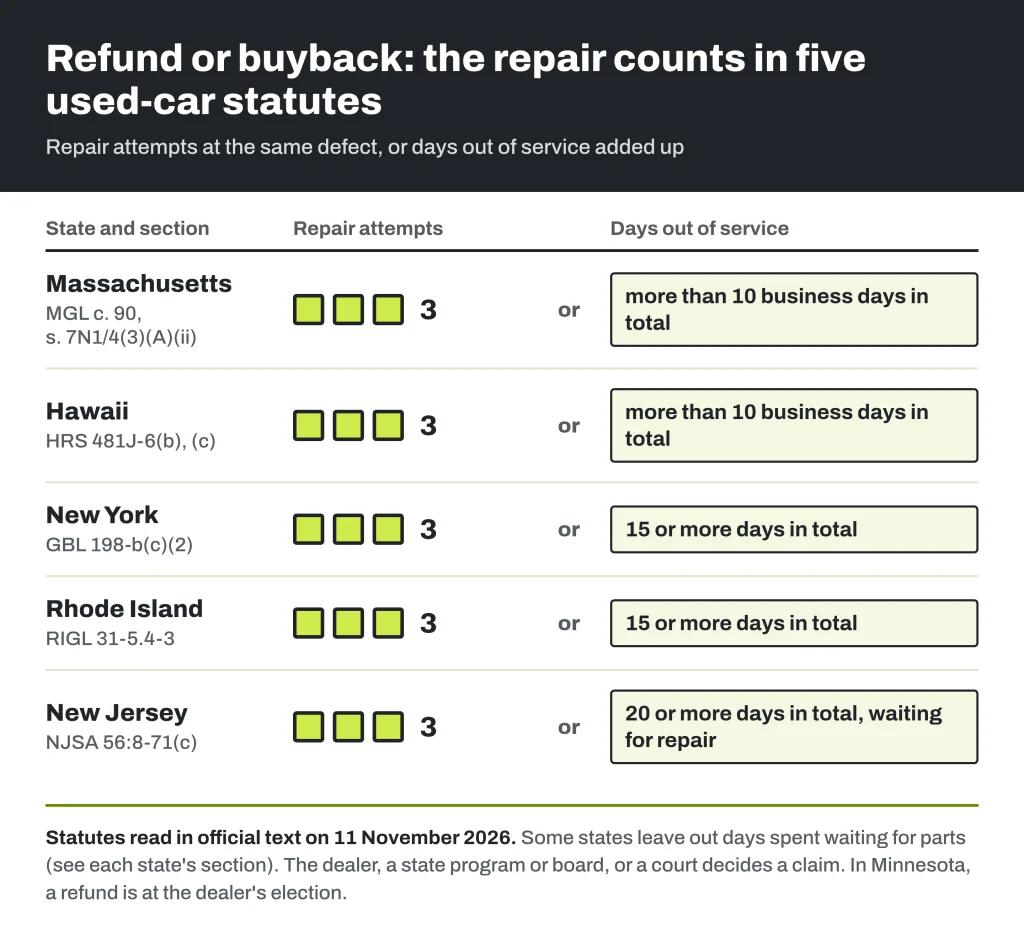
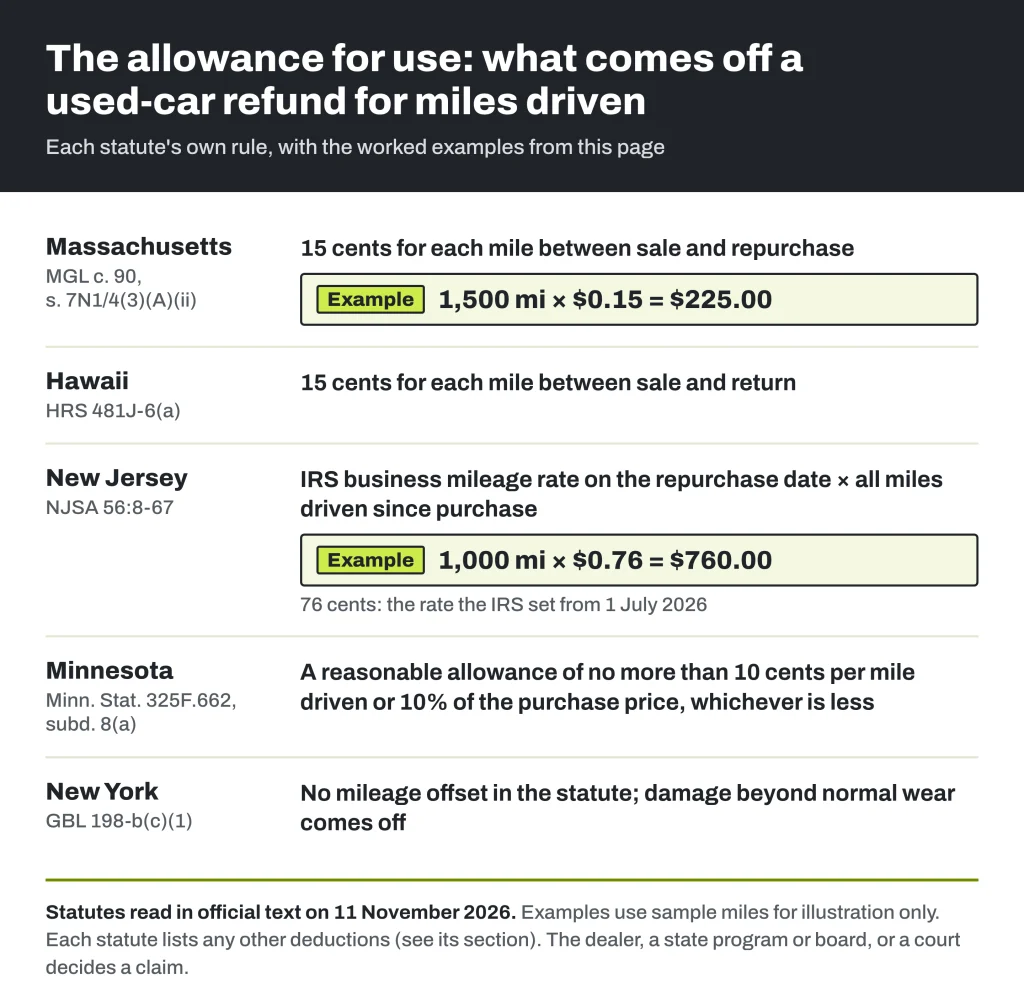
- Refund: if the dealer fails to correct a defect “after a reasonable period of time”, it must take the car back and refund the full purchase price, including general excise tax, less damage beyond normal wear (481J-6(a)). A reasonable chance is presumed after three failed attempts at the same defect, or more than a cumulative ten business days out of service. Days waiting for an ordered part don’t count, for up to 21 days (481J-6(b), (c)). The allowance for use is “fifteen cents for each mile” between sale and return (481J-6(a)). The dealer may offer a replacement, which you may refuse (481J-6(g)).
- Fees and time to sue: a consumer may sue and recover costs, “including reasonable attorney’s fees” (481J-7(a)). The action must be “commenced within one year of the date of original delivery of the used motor vehicle to the consumer” (481J-7(c)). An earlier date may apply.
- Official text: HRS 481J-2 and the other sections of chapter 481J, Hawaii State Legislature (no “current through” note on the page), read 11 November 2026.
Illinois: 15 days or 500 miles, powertrain
- Who it binds: retail used-car sales to a consumer after 1 July 2017 by a licensed dealer, or by an auction company at an auction open to the public (815 ILCS 505/2L(a)).
- Excluded: more than 150,000 miles, “rebuilt” or “flood” titles, 8,000 pounds gross vehicle weight rating or more, and antique or collector vehicles (2L(b)). Also excluded: sales where the dealer offers an express warranty at least equal to this one (2L(b-5)), and State Police forfeiture auctions (2L(b-6)).
- The rule: an implied warranty that the car “functions for the purpose of ordinary transportation on the public highway” and is “substantially free of a defect in a power train component” (2L(d)). It runs until midnight of the 15th calendar day after delivery, or 500 miles, whichever is earlier. Days in breach and repair miles don’t count (2L(c), (e)). The statute lists the powertrain parts: engine block, head, internal engine parts, oil pan and gaskets, water pump, intake manifold, transmission and its internal parts, torque converter, drive shaft, universal joints, rear axle and its internal parts, and rear wheel bearings (2L(d)).
- Notice and repairs: give the seller reasonable notice no later than 2 business days after the warranty period ends. Reasonable notice includes a text (if the seller gave you a cell phone number), a call or message to the business phone number on the bill of sale, or a letter to or visit at the seller’s address on the bill of sale (2L(f)). The seller gets “a reasonable opportunity to repair”. The consumer pays half of the first two repairs, at most $100 each, and at most $100 in total if the second repair is for the same defect (2L(f)). The seller’s liability is capped at the purchase price, refunded in exchange for the car (2L(g)).
- Waiver: only for a particular disclosed defect, with a signed statement (2L(j)). Breaking the section is an unlawful practice under the Consumer Fraud Act (2L(m)).
- If you sue under the Consumer Fraud Act: an action for damages must be “commenced within 3 years after the cause of action accrued” (815 ILCS 505/10a(e)). Against a dealer, at least 30 days before filing you must serve a written notice of the violation and a demand for relief, and the dealer may answer with a written settlement offer (10a(h)). A claim against a dealer also needs proof of a public injury, a pattern or an effect on consumers generally (10a(a)). The court may award reasonable attorney’s fees and costs to the prevailing party, which can be either side, and rejecting a written settlement offer can cut off fees if the judgment is lower (10a(c), (f), (h)). An earlier date may apply.
- Official text: 815 ILCS 505/2L and 505/10a on the Illinois General Assembly site, read 11 November 2026 in the legislature’s own file repository, updated 30 October 2026 with Public Acts through 104-854.
Maine: inspection warranty, plus the lemon law for later owners
- The dealer warranty: a dealer warrants that a used car it sells “has been inspected” under Maine’s inspection law (Title 29-A, section 1751) and “is in the condition and meets the standards required” (10 MRSA 1474(1)(A)). A car sold as a reconstructable vehicle is instead warranted only to be in the condition its posted “unsafe motor vehicle” disclosure describes (1474(1)(B), (4)). This warranty and the remedies for breaking it “may not be excluded, limited, modified or waived” (1474(2)). The dealer’s written statement must tell you to give the dealer written notice by registered or certified mail before suing under section 1476 (1474(3)(A)(2)). We have not read section 1476 or any time limit for that suit.
- The new-car lemon law can reach a used car: Maine’s “consumer” includes “any person to whom the motor vehicle is transferred during the duration of an express warranty” (10 MRSA 1161(1)). The repair duty covers defects reported during the express warranty, within 3 years of the original delivery or the first 18,000 miles, whichever occurs earliest (1163(1)). A second owner inside those limits is within the definitions. Businesses that register 3 or more vehicles are not consumers (1161(1)).
- “As is”: Maine’s general rule makes disclaimers of implied warranties on consumer goods, new or used, unenforceable, though a car seller may print that it disclaims them “to the extent permitted by law” (11 MRSA 2-316(5)).
- Official text: 10 MRSA 1474, 1161 and 1163, Maine Legislature (the site says its data was extracted on 5 October 2026), read 11 November 2026.
Massachusetts: 30 to 90 days, buyback at 15 cents a mile
- Who it binds: a dealer, meaning anyone who sold more than three used cars in the preceding twelve months. Banks and government sellers are not dealers. Auto homes, off-road vehicles, motorcycles and vehicles used mainly for business are excluded (MGL c. 90, s. 7N1/4(1)). So are sales under $700 (7N1/4(7)) and sales by a lessor to its lessee or by an employer to an employee (7N1/4(12)).
- The rule: a written warranty covering the full cost of parts and labor to repair “any defect that impairs” the car’s “safety or use”. You pay no more than $100 in total during the warranty. Defects that affect only appearance don’t count (7N1/4(2)(A)(i)). Terms by mileage at sale, whichever comes first: under 40,000 miles, 90 days or 3,750 miles; 40,000 to under 80,000, 60 days or 2,500 miles; 80,000 to under 125,000, 30 days or 1,250 miles. Where the true mileage isn’t known, the term follows the car’s age (7N1/4(2)(B)). The term pauses while the car is out of service for warranty repair, and runs 30 days past a repair finished near its end (7N1/4(2)(C)). It also pauses while the car is out for repair under the maker’s warranty (7N1/4(2)(A)(ii)), and the warranty periods don’t run until the dealer gives you the written notice of these rights (7N1/4(4)).
- Return and buyback: present the car to the dealer, and tell the dealer of the defect, no later than five business days after the warranty ends. That return period is tolled while you have notified the dealer but can’t reasonably present the car, for example because it won’t run and the dealer refuses to pay for the tow (7N1/4(3)(A)(i)). If the dealer fails to repair the same defect within three attempts, or the car is out of service more than a cumulative ten business days, the dealer must take it back and refund the full repurchase price. A business day is Monday to Friday, except state or federal holidays (7N1/4(1)). Days when a part the dealer ordered promptly isn’t yet in hand don’t count toward the ten, for up to 21 days (7N1/4(3)(A)(ii)). The allowance for use is “fifteen cents for each mile” between sale and repurchase (7N1/4(3)(A)(ii)). Example: 1,500 miles x $0.15 = $225.00.
- State arbitration: if you request it within six months of the original delivery to you, the dealer must take part in state-certified used-car arbitration. The state’s arbitration page says the application must be received within those six months. The finding is due within 45 days. A dealer who neither pays within 21 days nor appeals faces a fine of $50 a day, up to $500. A consumer unhappy with a finding may also bring a claim under chapter 93A, and the same paragraph says “any prevailing consumer shall be awarded reasonable attorneys’ fees and costs” (7N1/4(3)(A)(iii)). See how lemon lawyers are paid for each state’s fee rule.
- If the maker’s warranty still applies: make a reasonable effort to get the repair or relief under it first (7N1/4(10)).
- Private sellers: they must disclose known defects that impair safety or substantially impair use. If they don’t, the buyer may cancel the sale within 30 days (7N1/4(8)).
- Time to sue: within two years of the original delivery of the used car to you (7N1/4(13)). An earlier date may apply.
- Official text: MGL c. 90, s. 7N1/4, Massachusetts Legislature (no version note on the page), read 11 November 2026.
Minnesota: 15 to 60 days, dealer warranty on listed parts
- Who it covers: passenger cars, pickups and vans bought from a dealer for mainly personal, family or household use (Minn. Stat. 325F.662, subd. 1).
- The rule: “Every used motor vehicle sold by a dealer is covered by an express warranty”. Terms, whichever comes first: under 36,000 miles, 60 days or 2,500 miles; 36,000 to under 75,000, 30 days or 1,000 miles; 75,000 to under 200,000, 15 days or 500 miles, except when the seller is a new-car dealer (subd. 2(a)). The covered parts are listed in subd. 2(c) and (d). If the dealer gives no warranty, it “is considered to have given” one (subd. 5).
- Excluded: a total cash price under $3,000, diesel engines, over 9,000 pounds, show or race cars, cars eight years old or older, small makers, 200,000 miles or more, non-compliant cars and salvage titles. The $3,000 and eight-year exclusions don’t apply to the 75,000 to 200,000 mile tier (subd. 3).
- Repair or refund: the dealer must “repair or replace the covered part, or at the dealer’s election” take the car back and refund (subd. 2(b)). The refund is the full price and other charges, less “a reasonable allowance” for your use “not exceeding ten cents per mile driven or ten percent of the purchase price, whichever is less” (subd. 8(a)). That is a cap, not a set amount. The dealer’s duty continues after the warranty ends if you promptly notified the dealer of the failure within the warranty period and, within a reasonable time after that, brought the car to the dealer or arranged for it to be brought (subd. 2(e)). The dealer doesn’t have to repair a part the maker’s new-car warranty covers (subd. 2(f)).
- Waiver: only for a part disclosed as defective on the front of the Buyers Guide, which you circle and sign (subd. 4).
- Time to sue: within one year of the express warranty’s expiration (subd. 10). An earlier date may apply.
- Official text: Minn. Stat. 325F.662, 2026 Minnesota Statutes, read 11 November 2026.
New Jersey: 30 to 90 days, repurchase after 3 repairs or 20 days
- Who it binds: a dealer that sold or offered three or more used vehicles in the previous 12 months. Covers passenger vehicles bought for personal, family or household use. Motorcycles, motor homes and off-road vehicles are excluded, as is a lessee’s buyout after a lease of more than 90 days (NJSA 56:8-67).
- The rule: a written warranty, whichever comes first: 24,000 miles or less, 90 days or 3,000 miles; more than 24,000 but less than 60,000, 60 days or 2,000 miles; 60,000 or more, 30 days or 1,000 miles (56:8-69). It covers the powertrain parts listed in 56:8-67, with a $50 deductible per repair. Repairs covered by the maker’s warranty or a safety recall are excluded, as are collision, abuse, missed maintenance and commercial use (56:8-70). If the dealer gives no warranty, it is deemed given (56:8-74).
- Not covered: sold for less than $3,000, seven or more model years old, a disclosed insurance total loss, or more than 100,000 miles (56:8-76). Over 60,000 miles, a buyer may waive the warranty after a price negotiation, in a separate signed writing (56:8-73).
- Repurchase: if, within the warranty period, the dealer fails to correct a material defect (one that “substantially impairs its use, value or safety”, 56:8-67) after a reasonable opportunity to repair, it must repurchase and refund the full price, excluding sales tax and title and registration fees, less excessive wear and a “deduction for personal use” (56:8-71(a)). A reasonable opportunity is presumed after three repairs of the same defect within the warranty, or 20 or more cumulative days out of service waiting for repair (56:8-71(c)). The personal-use deduction is the IRS business mileage rate in effect on the repurchase date times all miles you drove since purchase (56:8-67). Example: 1,000 miles at the 76-cent rate the IRS set from 1 July 2026 = $760.00.
- Time to sue: the act states none. A general limit may apply, which we have not read.
- Official text: NJSA 56:8-67 to 56:8-80 in the New Jersey Legislature’s statutes database (search “56:8-67”), read 11 November 2026. The Division of Consumer Affairs runs a Lemon Law Unit.
New Mexico: 15 days or 500 miles, implied warranty
- Who it binds: a “used motor vehicle dealer”, one that sold or offered four or more used vehicles in the previous twelve months. Banks, insurers, employer-to-employee and lessor-to-lessee sales are excluded (NMSA 57-16A-2(H)). A “motor vehicle” is a passenger vehicle, including a car, pickup, motorcycle or van, sold and registered in New Mexico and under 10,000 pounds gross vehicle weight (57-16A-2(F)).
- The rule: the dealer can’t exclude, modify or disclaim the implied warranty of merchantability before midnight of the 15th calendar day after delivery, or 500 miles, whichever is earlier. Days in breach and repair miles don’t count (57-16A-3.1(B)). The car must function “substantially free of a defect that significantly limits” its use for ordinary transportation (3.1(C)).
- Notice and repairs: give the seller reasonable notice “within thirty days of the date of the breach”. The seller gets a reasonable opportunity to repair. You pay half of the first two repairs, at most $25 each (3.1(E)). The seller’s liability is capped at the purchase price in exchange for the car, unless the seller knew or should have known of the defect and didn’t disclose it (3.1(F)).
- Time to sue: the section sends both sides to New Mexico’s UCC, chapter 55, article 2 (3.1(K)), and sets no period of its own. The Motor Vehicle Quality Assurance Act, which includes this section, says “any action brought to enforce the provisions” of the Act “shall be commenced within eighteen months following the date of original delivery of the motor vehicle to a consumer”, or, if the consumer used a maker’s dispute program under 57-16A-6, within 90 days after the panel’s final action, whichever is later (57-16A-8). How that fits with the UCC remedies is for a court. An earlier date may apply.
- Official text: NMSA 57-16A-2, 57-16A-3.1 and 57-16A-8 in chapter 57 on NMOneSource, the official compilation (chapter file dated 20 June 2025), read 11 November 2026.
New York: 30 to 90 days, refund after 3 repairs or 15 days
- Who it binds: a dealer that sold, offered for sale, leased or offered for lease three or more used vehicles in the previous twelve months (GBL 198-b(a)(3)). Covers buyers and lessees for mainly personal, family or household use, and a spouse or child the car passes to during the warranty (198-b(a)(1)). A “used motor vehicle” was bought, leased or transferred after 18,000 miles or two years from original delivery, whichever is earlier. Motor homes and off-road vehicles are excluded (198-b(a)(2)).
- The rule: a written warranty, whichever comes first: 36,000 miles or less, 90 days or 4,000 miles; more than 36,000 but less than 80,000, 60 days or 3,000 miles; 80,000 to 100,000, 30 days or 1,000 miles (198-b(b)(1)). Covered parts include the engine, transmission, drive axle, brakes, radiator, steering, alternator, generator, starter and ignition system, but not the battery (198-b(b)(2)). Report a failure within the warranty and the dealer must repair it even after the warranty ends (198-b(b)(3)). The warranty is extended while the dealer has the car for warranty repair (198-b(c)(3)).
- Not covered: sold for less than $1,500, more than 100,000 miles if that mileage is stated in writing at sale, and historical vehicles (198-b(d)(3)). Any waiver is “void as contrary to public policy” (198-b(d)(1)).
- Refund: if the dealer fails to correct a defect that substantially impairs the car’s value after a reasonable period, it must take the car back and refund the full purchase price, including sales tax, less damage beyond normal wear (198-b(c)(1)). A reasonable chance to repair is presumed after three or more repairs of the same defect within the warranty, or 15 or more cumulative days out of service during the warranty. Days waiting for parts don’t count, but 45 days in total qualify regardless (198-b(c)(2)). There is no mileage offset. The dealer may offer a replacement, which you may refuse. If the refund won’t pay off a car loan, the dealer must tell you by registered or certified mail that you have 30 days to pay the lender the difference; if you don’t, the dealer’s refund duty ends (198-b(c)(1)).
- Program first: if the dealer has a dispute program that complies with 16 CFR 703, the refund and replacement rules apply only after you use it (198-b(f)(1)). You may instead choose the Attorney General’s arbitration for a filing fee (198-b(f)(3)): $120 for a used car on the AG’s 2025 form.
- Fees and time to sue: a court may award attorney’s fees to a prevailing plaintiff (198-b(f)(5)). An action must be “commenced within four years of the date of original delivery of the used motor vehicle to the consumer” (198-b(f)(6)). An earlier date may apply.
- Official text: GBL 198-b, New York State Senate (“most recent revision” dated 22 September 2014), read 11 November 2026.
Rhode Island: 30 or 60 days, but “as is” is allowed
- Who it binds: a dealer that sold or offered three or more used vehicles in the previous 12 months. Banks, employer-to-employee and lessor-to-lessee sales, and the state are excluded (RIGL 31-5.4-1(2)). Motorcycles, motor homes and off-road vehicles are excluded (31-5.4-1(5)), as are sales under $1,500 and classic cars (31-5.4-4(d)).
- The rule: a written warranty, whichever comes first: 36,000 miles or less, 60 days or 3,000 miles; more than 36,000 up to 100,000, 30 days or 1,000 miles (31-5.4-2(a)). The dealer repairs, or at its election reimburses, failures of listed parts (31-5.4-2(b)). If the maker’s new-car warranty is still running, this warranty covers only any gap after it ends (31-5.4-2(d)). Report a failure within the warranty and the dealer must repair it even after the warranty ends (31-5.4-2(c)). The warranty is extended while the dealer has the car for warranty repair (31-5.4-3(c)).
- “As is” is allowed: a buyer can waive these rights, but the dealer must post a windshield notice reading “NO WARRANTY AS TO CONDITION — SOLD AS IS”, and print the waiver on the bill of sale, initialed by both (31-5.4-4).
- Refund: if the dealer fails to correct a defect that substantially impairs the car’s value, a reasonable chance to repair is presumed after three repairs of the same defect within the warranty, or 15 or more cumulative days out of service during the warranty, and the dealer must take the car back and refund the full price, including sales tax, less damage beyond normal wear. Days waiting for parts don’t count, but 45 days in total qualify regardless (31-5.4-3(a), (b)). As in New York, if the refund won’t pay off a car loan, you get 30 days after the dealer’s registered or certified letter to pay the lender the difference, or the refund duty ends (31-5.4-3(a)). If the dealer has a 16 CFR 703 dispute program, use it first (31-5.4-5(a)).
- Fees and time to sue: the court may award fees to a prevailing plaintiff (31-5.4-5(c)). Sue “within four (4) years of the date of original delivery of the used motor vehicle to the consumer” (31-5.4-5(d)). An earlier date may apply.
- Official text: RIGL chapter 31-5.4, Rhode Island General Assembly, read 11 November 2026.
West Virginia: “as is” only in listed cases
- The general rule: in a consumer sale, a merchant may not exclude or limit “any warranty, express, or implied” (WV Code 46A-6-107(a)).
- The used-car exception: a used car may be sold “as is” only if it is inoperable and a total loss, built or modified for show or racing, or sold for less than $4,000, driven more than 100,000 miles, or seven years old or older from 1 January of the model year (46A-6-107a(a)). The merchant must use the boxed “AS IS” disclaimer on the front page, signed and dated inside the box. It must describe in writing any defects a previous owner disclosed or an inspection would find, and give a copy of a vehicle history report (46A-6-107a(d)).
- Cancel right: after an “as is” sale under the price, mileage or age test, the buyer may cancel by returning the car “by the end of the dealer’s third business day following the sale”, if it has a significant mechanical issue that could reasonably be expected to have existed at the sale (46A-6-107a(b)).
- Limits: the section applies only to sales directly to consumers, not to state surplus sales (46A-6-107a(f), (g)). An “as is” sale doesn’t waive express warranties you relied on (46A-6-107a(e)).
- Official text: WV Code 46A-6-107a and 46A-6-107, West Virginia Legislature, read 11 November 2026 (last changed by SB 543, 2019).
Every state: three federal rules
Where your state has none of the laws above, federal law still sets the ground rules for a dealer sale. None of them is a lemon law, but each can decide what you’re owed.
1. The Buyers Guide is part of your contract. The FTC’s Used Car Rule makes dealers display a Buyers Guide on each used car they offer (16 CFR 455.2(a)). It shows whether the car comes “as is”, with implied warranties only, or with a dealer warranty, and if so, which systems it covers, for how long, and what share of each repair you pay (455.2(b)). The rule says: “The information on the final version of the window form is incorporated into the contract of sale” and “overrides any contrary provisions in the contract of sale” (455.3(b)). Where state law limits or bans “as is” sales, “that State law overrides this part” (455.2(b)(1)(ii)). The rule counts only sellers that sold or offered five or more used vehicles in the previous twelve months as dealers, and it doesn’t cover motorcycles (455.1(d)). Keep your copy: it is often the only written promise in a used-car deal. Our Buyers Guide and “as is” guide goes through each box. The FTC also said in 1995 that Wisconsin and Maine had received exemptions under 455.6 (60 FR 62195). We have not confirmed whether, or how far, they still apply.
2. A service contract with the dealer within 90 days ends “as is”. Under the Magnuson-Moss Warranty Act, no supplier may disclaim or modify an implied warranty if it gives a written warranty, or if “at the time of sale, or within 90 days thereafter, such supplier enters into a service contract with the consumer which applies to such consumer product” (15 U.S.C. 2308(a)). A disclaimer made in breach of this “shall be ineffective for purposes of this chapter and State law” (2308(c)). So a car marked “as is” keeps its implied warranties when the dealer is the party to the service contract, often sold as an extended warranty. The Buyers Guide repeats the point (16 CFR 455.2(b)(3)).
3. A second owner can use the maker’s warranty, and sometimes the new-car lemon law. Magnuson-Moss defines a “consumer” to include “any person to whom such product is transferred during the duration of an implied or written warranty” (15 U.S.C. 2301(3)). So if you buy a car while its factory warranty is still running, you count as a “consumer” under the Act; the warranty booklet’s own terms still set what it covers. See our Magnuson-Moss guide. Several state new-car lemon laws also count later owners, but a second owner may have little of the window left: New York’s, for example, runs from the car’s original delivery (GBL 198-a(b)(1)). Examples we read: New York’s new-car law covers a car that had a maker’s express warranty at original delivery and was either bought, leased or transferred in the state within its first 18,000 miles or two years from original delivery, whichever is earlier, or is registered in the state (GBL 198-a(a)(2)). New Jersey’s “consumer” includes “a person to whom a motor vehicle is transferred during the duration of a warranty” (NJSA 56:12-30). Massachusetts and Arizona use similar definitions (MGL c. 90, s. 7N1/2(1); ARS 44-1261(A)(1)). Each state’s window is in our lemon laws in all 50 states and DC table.
Some states also void “as is” disclaimers on consumer goods generally, used cars included, with no used-car statute of their own. Examples are Kansas (K.S.A. 50-639) and Maryland, which has an exception for titled cars over 6 model years old with more than 60,000 miles sold with the state form (Com. Law 2-316.1(4)). The Buyers Guide page linked above goes through these rules.
What these laws don’t cover
- Most private sales. The dealer laws apply to sellers with a minimum number of sales: 3 in New York, New Jersey and Rhode Island, “more than three” in Massachusetts, 4 in Arizona and New Mexico, and 5 for the federal Buyers Guide. Massachusetts is the exception that reaches private sellers: they must disclose known defects that impair safety or substantially impair use (7N1/4(8)).
- High mileage and cheap or old cars. Coverage stops at 100,000 miles in New York (if stated in writing), New Jersey and Rhode Island; below 125,000 in Massachusetts; at 150,000 in Illinois; at 200,000 in Minnesota; and at 75,000 in Hawaii (if stated in writing). Price floors run from $700 (Massachusetts) to $3,000 (Connecticut, New Jersey, Minnesota). Age cut-offs are 5 years in Hawaii, 7 in Connecticut and New Jersey, and 8 in Minnesota. Minnesota’s price floor and age cut-off don’t apply to its 75,000 to 200,000 mile tier (325F.662, subd. 3).
- Motorcycles and motor homes are excluded in some of these laws. Massachusetts, New Jersey and Rhode Island exclude motorcycles by name. New York excludes motor homes and off-road vehicles but not motorcycles. New Mexico’s definition includes motorcycles.
- Damage after the sale from collision, abuse, neglect, missed maintenance, racing or towing is excluded in each statute that lists exclusions.
Claims you may see elsewhere
You may see these on other sites. We checked each against the statute, and it isn’t what the text says.
- “Only six or seven states have a used-car lemon law.” The statutes we read give twelve states with a used-car rule of some kind, plus DC’s disclosure duty. They differ widely, so a count says little: read your state’s row.
- “Arizona, Illinois and New Mexico have no used-car law.” Each has a 15-day or 500-mile implied warranty a covered dealer can’t disclaim (ARS 44-1267; 815 ILCS 505/2L; NMSA 57-16A-3.1).
- “A used-car lemon law covers every used car.” Every statute above has a dealer test and exclusions by price, mileage, age or vehicle type.
What to keep, and where to go next
Several of these laws turn on what you can show, and on when you told the dealer. Keep:
- Your copy of the Buyers Guide and the sales contract, with the price, the mileage at sale and any signed waiver or “as is” box.
- Any written warranty from the dealer, and any service contract, with its date (the 90-day rule in 15 U.S.C. 2308(a) runs from the sale).
- Every repair order, with the date, the mileage, the problem as you described it, the work done, and the days the car was in the shop.
- A record of each time you told the dealer, how you told it, and when. Notice rules differ. Illinois: within 2 business days after the warranty ends (505/2L(f)), and, before suing a dealer under the Consumer Fraud Act, a written notice and demand at least 30 days before filing (505/10a(h)). New Mexico: within 30 days of the breach (57-16A-3.1(E)). Massachusetts: present the car within 5 business days after the warranty ends, a period tolled while you have notified the dealer but can’t reasonably present the car (7N1/4(3)(A)(i)). Hawaii: present the car with written notice of the defect before the warranty ends (481J-2(f)). New York, Rhode Island and Connecticut: report the failure within the warranty period (GBL 198-b(b)(3); RIGL 31-5.4-2(c); CGS 42-222). Minnesota: notify the dealer promptly within the warranty period, then bring the car in within a reasonable time (325F.662, subd. 2(e)). Maine: written notice by registered or certified mail before suing (10 MRSA 1474(3)).

Then read your state’s statute through the link in its fold-out, and the state’s own consumer office. The New York Attorney General runs used-car arbitration (ag.ny.gov). Massachusetts’s Office of Consumer Affairs and Business Regulation runs the state-certified used-car arbitration (mass.gov). New Jersey’s Division of Consumer Affairs has a Lemon Law Unit. If the car is still under the maker’s warranty, the lemon law checker shows the numbers in your state’s new-car law. The deadline lookup gives each new-car law’s time limit as a rule in words. If a dealer won’t honor a warranty at all, when the dealer won’t fix your car covers complaints and the next steps.
Fact-check note. Statutes and rules checked on 11 November 2026, each in official text: ARS 44-1261, 44-1265 and 44-1267; CGS 42-220 to 42-226a (with the 2026 Supplement note); DC Code 50-505; HRS 481J-1 to 481J-7; 815 ILCS 505/2L and 505/10a (Illinois General Assembly file repository, Public Acts through 104-854); 10 MRSA 1161, 1163 and 1474; MGL c. 90, s. 7N1/4; Minn. Stat. 325F.662 (2026 Minnesota Statutes); NJSA 56:8-67 to 56:8-80 and 56:12-30; MGL c. 90, s. 7N1/2(1); NMSA 57-16A-1, 57-16A-2, 57-16A-3.1 and 57-16A-8 (NMOneSource chapter file dated 20 June 2025); GBL 198-a and 198-b; RIGL 31-5.4-1 to 31-5.4-6; WV Code 46A-6-107 and 46A-6-107a. Federal: 16 CFR part 455 (eCFR, last amended effective 27 January 2017); 15 U.S.C. 2301 and 2308 (US Code, 2024 edition); 60 FR 62195 (5 December 1995). The IRS business mileage rate (76 cents a mile from 1 July 2026) was read on irs.gov; it changes at least yearly. Also read for the “as is” notes: K.S.A. 50-639, Md. Com. Law 2-316.1, 11 MRSA 2-316 and DC Code 28:2-316.01. We recheck these rows every three months and after each state’s legislative session.
Sources
- Arizona Revised Statutes 44-1261 and 44-1267
- Arizona Revised Statutes 44-1265
- Connecticut General Statutes chapter 743f
- D.C. Code 50-505
- Hawaii Revised Statutes chapter 481J
- 815 ILCS 505/2L (Illinois General Assembly)
- Maine Revised Statutes, Title 10, sections 1161, 1163 and 1474
- Massachusetts General Laws c. 90, s. 7N1/4
- Minnesota Statutes 325F.662 (2026)
- New Jersey Statutes 56:8-67 to 56:8-80
- New Mexico Statutes 57-16A-3.1 (NMOneSource, chapter 57)
- New York General Business Law 198-b
- New York General Business Law 198-a
- Rhode Island General Laws chapter 31-5.4
- West Virginia Code 46A-6-107a
- 16 CFR part 455, Used Motor Vehicle Trade Regulation Rule (eCFR)
- 15 U.S.C. 2308, implied warranties
- 15 U.S.C. 2301, definitions
- IRS standard mileage rates
- New York Attorney General, Lemon law program
- Massachusetts Office of Consumer Affairs and Business Regulation, Apply for Lemon Law arbitration
- New Jersey Division of Consumer Affairs, Lemon Law Unit