California’s lemon law is the Song-Beverly Consumer Warranty Act, with its car rules in the Tanner Consumer Protection Act (one of our lemon laws by state guides). If the maker can’t fix a new car, truck or the driving part of a motor home to match its written warranty after a reasonable number of attempts, it must replace it or refund it, and the buyer may choose the refund (Civ. Code 1793.2(d)(2)); the law presumes enough attempts if, within 18 months or 18,000 miles, the same serious-safety defect was repaired 2 or more times or the same defect 4 or more times (with direct notice to the maker where the warranty or manual requires it), or the car spent more than 30 calendar days in the shop (1793.22(b)). Since 2025, makers on the Department of Consumer Affairs’ opt-in list also follow a second set of court procedures (Code of Civil Procedure 871.20 to 871.30), all read here in the official California code on 11 November 2026.
This page is general information, not legal advice and not a substitute for the advice of an attorney. Lemon laws, deadlines and required steps vary by state and change. The statute, the maker, a state board or a court decides a claim.
California in four numbers
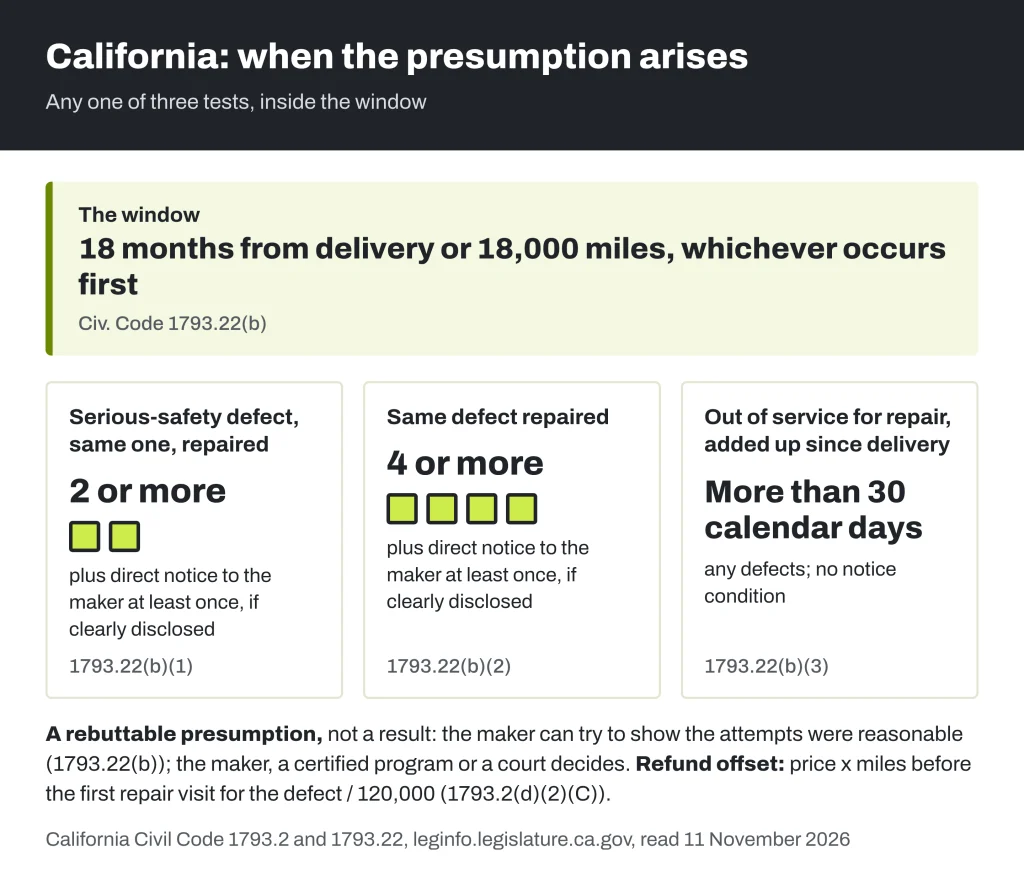
- 18 months or 18,000 miles from delivery, whichever comes first: the window for the presumption (Civ. Code 1793.22(b)). The duty to repair, replace or refund itself follows the maker’s written warranty (1793.2(d)).
- 4 repairs of the same defect, or 2 if the defect is likely to cause death or serious bodily injury, plus direct notice to the maker at least once where the warranty or owner’s manual clearly requires it (1793.22(b)(1)-(2)).
- More than 30 calendar days out of service for repairs, added up since delivery (1793.22(b)(3)).
- Price x miles / 120,000: the use offset the maker may take off a refund, counting the miles driven before the car first went in for the defect (1793.2(d)(2)(C)).
Source: California Civil Code sections 1793.2 and 1793.22 on leginfo.legislature.ca.gov, read 11 November 2026.
Two procedures since 2025
Many “California lemon law” pages online still describe one system. Since 2025 there are two, and which one applies depends on the carmaker, not on you.
- Makers that did not opt in are governed by the Song-Beverly Act as it has long worked: the Civil Code rules on this page, with no filing period of its own and no pre-suit notice required before a lawsuit (a written notice to the maker matters for one civil penalty, under 1794(e), below).
- Makers that opted in are also governed by the same Civil Code rights, but a lawsuit for a refund or replacement runs under Code of Civil Procedure 871.20 to 871.30: a written demand to the maker at least 30 days before suing for civil penalties, a deadline to sue, early mediation, set refund adjustments and payment times (871.20(a); 871.28 says the chapter adds to other laws rather than replacing them).
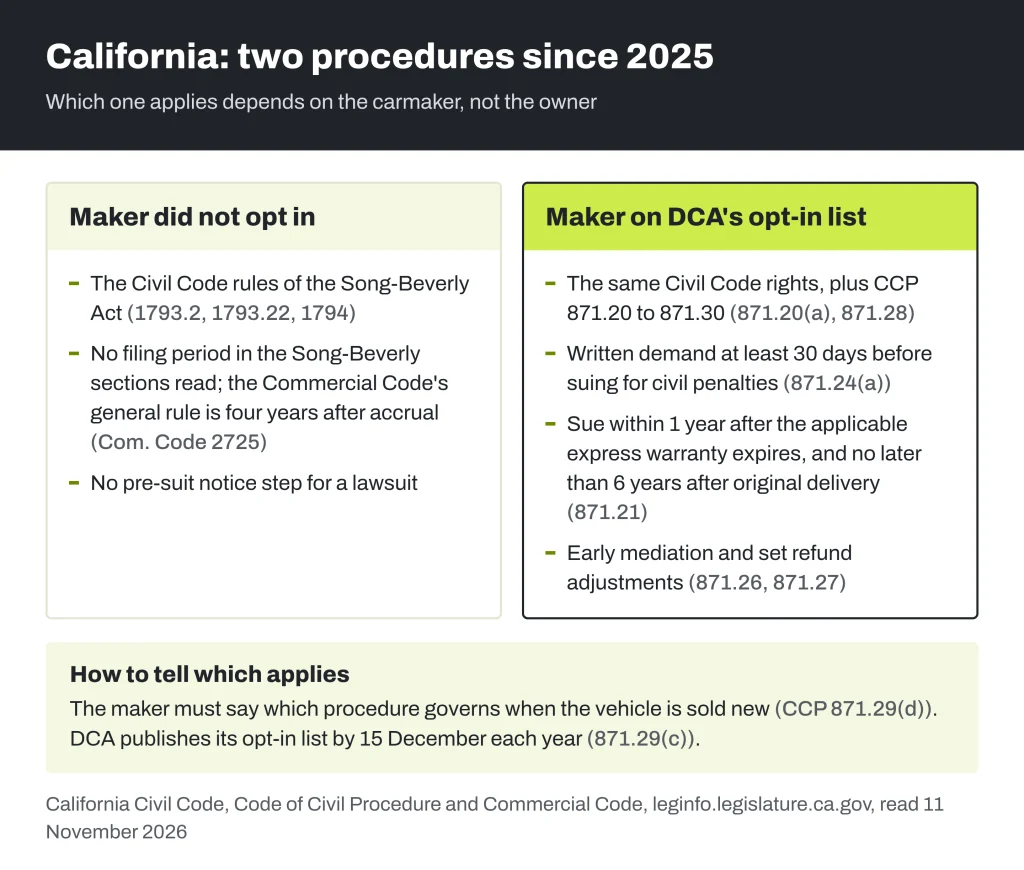
A maker opts in by written notice to the Arbitration Certification Program of the Department of Consumer Affairs (DCA), and the election covers “all of the manufacturer’s motor vehicles sold during a period of five consecutive calendar years”. It can’t be revoked during those five years (CCP 871.29(a)). A separate one-time election in spring 2025 let makers bring in vehicles sold in 2025 “and in all prior years” (871.30(a)). Without an election that covers the year your vehicle was sold, the new chapter doesn’t apply (871.29(b), 871.30(c)).
How to tell which applies to your vehicle. Two places, both official:
- The maker must tell the buyer, when a vehicle is sold new, which procedure governs it: the new chapter or the Civil Code’s warranty article (CCP 871.29(d)). Look through your sale papers and the warranty booklet for that notice.
- DCA must publish its list of makers that elected the new procedure “for a period that includes the following calendar year” by 15 December each year (871.29(c)). The list is at DCA’s opt-in manufacturers page. On 11 November 2026 it had 59 entries. It shows the date each maker opted in, but not which sale years each election covers, so the notice from your sale and the maker itself are the way to confirm it for your vehicle. We recheck the list after 15 December 2026.
DCA’s opt-in list as read on 11 November 2026 (59 entries)
Copied from DCA’s own list, in its spelling, read 11 November 2026. Being on the list or off it says nothing about a maker’s vehicles or how it handles claims; it only says which court procedure the maker chose.
Car, truck, motorcycle and chassis makers (21): FCA US LLC; Ford Motor Company; Freightliner Custom Chassis Corporation; General Motors LLC; Genesis Motor America; Hyundai Motor America; Indian Motorcycle Company; Ineos Automotive Americas, LLC; Infiniti USA; Isuzu; Jaguar Land Rover North America, LLC; Kia America, Inc.; Kovington Performance Holdings, Inc. (doing business as Roush Performance); Lotus Cars USA, Inc.; Maserati North America Inc.; Mercedes-Benz USA, LLC; Mitsubishi Motors North America, Inc.; Nissan North America; Polaris Industries Inc.; Subaru of America, Inc.; VinFast Auto, LLC.
RV, trailer and van makers (38 entries): Airstream Inc.; Alliance RV, LLC; Bowlus Road Chief LLC; Cruiser RV, LLC; DRV, LLC; Ember Recreational Vehicles, Inc. (opted in 9 September 2025); Forest River, Inc.; Foretravel Inc.; Genesis Supreme RV, Inc. (opted in 1 April 2026); Grand Design RV, LLC; Grech Motors Inc; Grech RV Inc; Heartland Recreational Vehicles, LLC; Jayco, Inc., and its d/b/a entries Entegra Coach, Highland Ridge RV and Starcraft RV; K. Z., Inc., and its d/b/a entries KZ Recreational Vehicles and Venture RV; KZRV, L.P.; Keystone RV Company, and its d/b/a entries Crossroads RV and Dutchmen RV; Lance Camper Mfg. Corp.; Newmar Corporation; REV Recreation Group, Inc., d/b/a American Coach, Fleetwood RV, Holiday Rambler and Midwest Automotive Designs; REV Renegade LLC; Remote Vans LLC; Roadtrek Inc.; Rossmonster Vans LLC; Thor Motor Coach; Tiffin Motor Homes, Inc; Winnebago Industries, Inc.; Winnebago of Indiana, LLC.
Every other entry was dated between 14 April and 13 May 2025. A brand that isn’t on the list follows the Civil Code procedure alone. Check DCA’s page itself before relying on this copy.
The coverage window
California’s duty to replace or refund isn’t capped at 18 months. It applies when the maker can’t conform the vehicle “to the applicable express warranties after a reasonable number of attempts” (1793.2(d)(2)), so it runs as long as the written warranty covers the defect. The 18-month, 18,000-mile limit is the window for the presumption (1793.22(b)): a shortcut in court that shifts the burden of proof to the maker. Outside it there is no presumption, and the owner has to show in some other way that the attempts were a reasonable number. DCA’s own FAQ puts it the same way: the law “applies throughout the duration of the vehicle manufacturer’s original warranty period” (DCA Arbitration Certification Program FAQ, read 11 November 2026).
Two more Civil Code rules frame the repairs themselves:
- 30 days per repair. Where the maker keeps repair facilities in California, warranty repairs must start within a reasonable time and, “unless the buyer agrees in writing to the contrary”, the goods must be brought into line with the warranty “within 30 days”. Delay from conditions beyond the maker’s control extends it (1793.2(b)).
- What counts as a defect. For cars the law uses the word nonconformity, meaning a failure to match the warranty “which substantially impairs the use, value, or safety of the new motor vehicle to the buyer or lessee” (1793.22(e)(1)). A rattle and a stalling engine are not treated alike.
The presumption: repairs and days
Section 1793.22(b) presumes “a reasonable number of attempts” were made if, within 18 months from delivery or 18,000 miles on the odometer, whichever occurs first, one or more of these happened:
“(1) The same nonconformity results in a condition that is likely to cause death or serious bodily injury if the vehicle is driven and the nonconformity has been subject to repair two or more times by the manufacturer or its agents, and the buyer or lessee has at least once directly notified the manufacturer of the need for the repair of the nonconformity.
(2) The same nonconformity has been subject to repair four or more times by the manufacturer or its agents and the buyer has at least once directly notified the manufacturer of the need for the repair of the nonconformity.
(3) The vehicle is out of service by reason of repair of nonconformities by the manufacturer or its agents for a cumulative total of more than 30 calendar days since delivery of the vehicle to the buyer.”
California Civil Code 1793.22(b), read on leginfo 11 November 2026
Read closely, the text has five points the one-line summaries leave out:
- Direct notice to the maker, not just the dealer, is part of the repair-count tests (1) and (2). But the buyer must give it “only if the manufacturer has clearly and conspicuously disclosed” that duty, with the provisions of this section, in the warranty or the owner’s manual, and it goes to the address the maker gives there (1793.22(b)). The days test (3) has no notice condition.
- The same defect for the repair counts. The days test adds up repairs of any nonconformities.
- Calendar days, more than 30. Exactly 30 doesn’t reach it. The 30-day limit is extended “only if repairs cannot be performed due to conditions beyond the control of the manufacturer or its agents”.
- It is rebuttable. The statute calls it “a rebuttable presumption affecting the burden of proof”, which the buyer may assert in any civil action, “including an action in small claims court”, or in another formal or informal proceeding. The maker can try to show the attempts were reasonable after all.
- It is a starting point, not a result. Reaching the numbers doesn’t decide a claim, and missing them doesn’t end one: the question in 1793.2(d)(2) is still whether the maker had “a reasonable number of attempts”.
Our lemon law checker compares your own repair count and days with these numbers and lists what it can’t check, such as whether the defect “substantially impairs” use, value or safety. Other states count very differently: the lemon laws in all 50 states and DC sets them side by side.
Steps that come first
A certified maker program, if you were told about it
California has no state-run lemon law arbitration board. Instead, DCA certifies dispute programs that makers sponsor. If a “qualified third-party dispute resolution process” exists and the buyer “receives timely notification in writing” of it with a description of how it works, the buyer can’t use the presumption “until after the buyer has initially resorted to” that program. Notice isn’t timely if the buyer suffers any prejudice from a delay in giving it (1793.22(c)). The program is a condition for the presumption, not for suing: with no program, or if the buyer is dissatisfied with its decision, or the maker doesn’t promptly carry out a decision the buyer accepted, the buyer may assert the presumption in court, and the program’s findings and decision are admissible there (1793.22(c)).
To be qualified, a program must, among other things, meet the Federal Trade Commission’s rules for informal dispute programs in 16 CFR part 703 as they read on 1 January 1987, make decisions binding on the maker “if the buyer elects to accept the decision”, give the maker no more than 30 days after acceptance to carry it out, offer an independent inspection at no cost to the buyer when the arbitrator asks for one, and hold DCA certification (1793.22(d)). The statute doesn’t require a program to award civil penalties or attorney fees (1793.22(d)(7)). How the federal rules work is on our Magnuson-Moss Warranty Act page.
DCA’s state-certified arbitration page lists which makers sponsor a certified program and which program it is (three programs on 11 November 2026), says filing is free, and says decisions “usually come within 40 days” after the program gets the application. Under the statute a decision binds the maker only if the buyer accepts it (1793.22(d)(2)), and a buyer who is dissatisfied with the decision may still assert the presumption in court (1793.22(c)). Our lemon law arbitration guide covers what a hearing involves. Where a maker has no certified program, DCA’s arbitration page points owners to court and to mediation through the New Motor Vehicle Board.
Opt-in makers: a written demand 30 days before suing for penalties
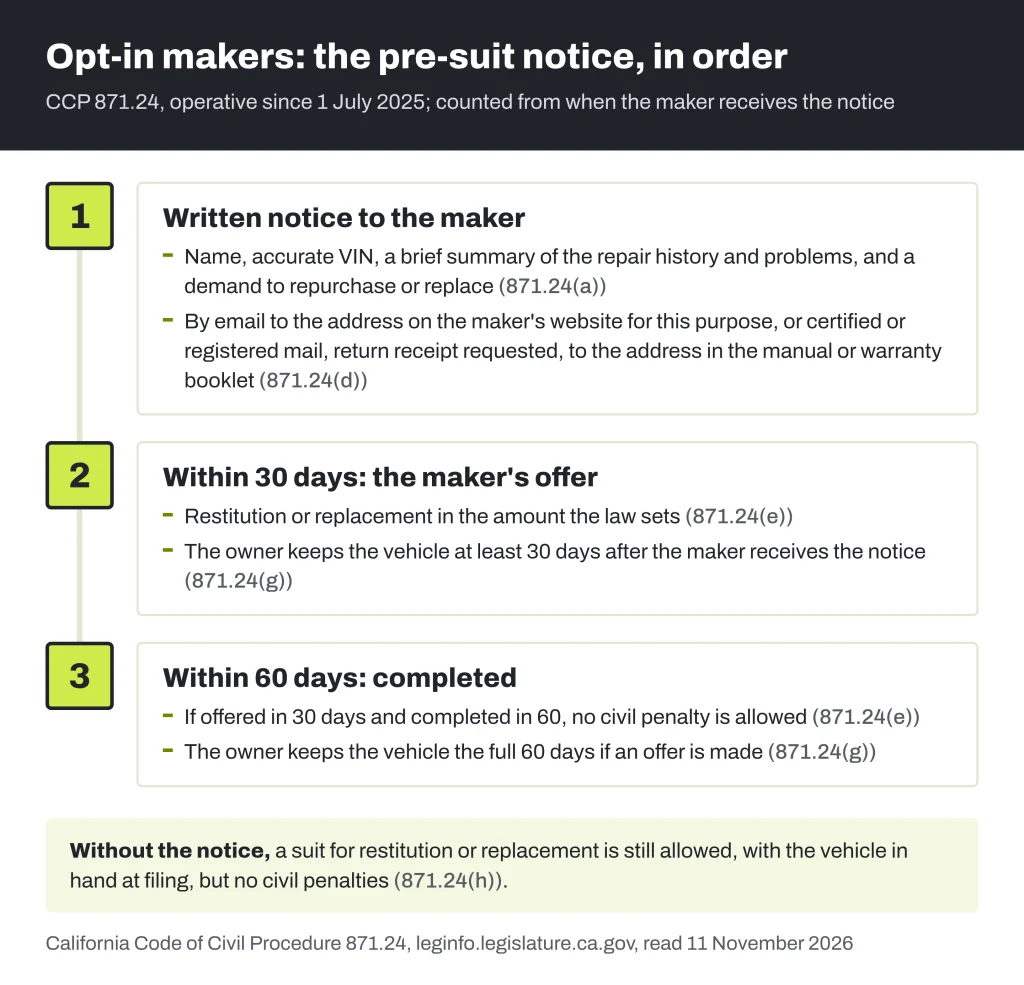
For makers on DCA’s list, CCP 871.24 adds a pre-suit step, operative since 1 July 2025 (871.24(k)). At least 30 days before suing for civil penalties, the owner must notify the maker of their name, the vehicle’s accurate VIN and “a brief summary of the repair history and problems”, and “demand that the manufacturer repurchase or replace the motor vehicle” (871.24(a)). The rules around it, as the section reads:
- How it’s sent: in writing, by email to the address “prominently displayed on the manufacturer’s website for this purpose”, or by certified or registered mail, return receipt requested, to the address in the owner’s manual or warranty booklet. Makers must give that information in English and Spanish (871.24(d)). Minor deviations in the notice don’t disqualify the owner (871.24(b)).
- The car: the owner must have it when the notice is sent and must keep it at least 30 days after the maker receives the notice, or the full 60 days if the maker makes an offer (871.24(c), (g)).
- The maker’s 30 and 60 days: no civil penalty is allowed if, within 30 days of receiving the notice, the maker offers restitution or replacement in the amount the law sets (plus reasonable attorney fees and costs if the owner has a lawyer), and the refund or replacement is completed within 60 days of receiving the notice (871.24(e)).
- If no offer comes in 30 days, the owner may sell the vehicle and seek remedies including civil penalties, but penalties after a sale need a written disclosure to the buyer of the reason for the demand and any pending suit (871.24(g)(1), (i)).
- Fee disputes before a suit go to neutral, binding arbitration, and a dispute over fees alone doesn’t make an offer non-compliant (871.24(f)).
- Skipping the notice: an owner may sue for restitution or replacement without it, but must have the vehicle when the complaint is filed and then can’t seek civil penalties, by amendment or otherwise (871.24(h)).
- Good faith: the owner must act in good faith and answer the maker’s reasonable requests for the documents needed to complete a refund or replacement (871.24(e)(2), (j)).
We don’t post a demand letter. The section lists what the notice must contain and how it must be sent; the maker’s website, owner’s manual or warranty booklet give its address. Our page on how a lemon law claim is filed sets out the steps in order.
All makers: written notice for the 1794(e) penalty
Separately, Civil Code 1794(e) lets a buyer recover a civil penalty of up to twice their damages for a violation of the replace-or-refund duty without proving it was wilful. After the events giving rise to the presumption, “the buyer may serve upon the manufacturer a written notice” asking it to comply; without that notice there is no penalty under this subdivision, and none if the maker complies within 30 days of the notice (1794(e)(3)-(4)). A maker that keeps a qualified dispute program that “substantially complies” with 1793.22 isn’t liable for this penalty at all (1794(e)(2)).
Refund or replacement
When the maker can’t fix a new motor vehicle after a reasonable number of attempts, it “shall either promptly replace the new motor vehicle … or promptly make restitution”. The buyer decides: “the buyer shall be free to elect restitution in lieu of replacement, and in no event shall the buyer be required by the manufacturer to accept a replacement vehicle” (1793.2(d)(2)).
- A refund (restitution) is “the actual price paid or payable by the buyer, including any charges for transportation and manufacturer-installed options, but excluding nonmanufacturer items installed by a dealer or the buyer”, plus collateral charges “such as sales or use tax, license fees, registration fees, and other official fees”, plus incidental damages “including, but not limited to, reasonable repair, towing, and rental car costs actually incurred” (1793.2(d)(2)(B)).
- A replacement is “a new motor vehicle substantially identical to the vehicle replaced”, with the warranties a new vehicle of that kind normally carries. The maker also pays the sales or use tax, license, registration and other official fees on the replacement, plus the same incidental damages (1793.2(d)(2)(A)).
How the money is split between you and a lender, and what happens to a trade-in, is on our lemon law buyback explained page.
The use offset, worked
The maker “may” reduce a refund by an amount for the buyer’s use of the car before the defect first went in for repair. The statute fixes the arithmetic: the actual price paid or payable, including transportation and manufacturer-installed options, multiplied “by a fraction having as its denominator 120,000 and having as its numerator the number of miles traveled by the new motor vehicle prior to the time the buyer first delivered the vehicle to the manufacturer or distributor, or its authorized service and repair facility for correction of the problem that gave rise to the nonconformity” (1793.2(d)(2)(C)). On a replacement, the buyer pays the maker the same amount.
Two details matter. The miles stop at the first repair visit for the defect in dispute, not at the buyback; and the price in the formula is the price “including any charges for transportation and manufacturer-installed options”. The offset sentence doesn’t mention taxes or official fees, which the restitution rule lists separately as collateral charges, so our example leaves them out of the offset; that is our reading, and the maker, an arbitrator or a court applies it.
| Example (round numbers, not a real case) | Amount |
|---|---|
| Price paid or payable, incl. transportation and maker-installed options | $40,000 |
| Miles before the first repair visit for the defect | 6,000 |
| Use offset: $40,000 x 6,000 / 120,000 | $2,000.00 |
| Taxes and official fees paid (example) | $3,800 |
| Towing and rental actually paid (example) | $400 |
| Estimate: $40,000 + $3,800 + $400 – $2,000 | $42,200.00 |
The buyback and refund estimator runs the same formula on your own numbers and shows each step.
Extra adjustments for opt-in makers
In a lawsuit under the opt-in chapter, CCP 871.27 changes what goes into “the actual price paid or payable”:
- Optional equipment, theft-deterrent devices, surface-protection products, service contracts, extended warranties, debt-cancellation agreements and GAP financing bought from a third party are offset and aren’t recoverable. The same items supplied by the selling or leasing dealer, or an authorized retail facility for the maker, are recoverable (871.27(b)). If you bought an extended warranty you no longer need, our page on cancelling an extended warranty covers refund rules.
- Negative equity rolled in from a prior vehicle is offset (871.27(c)).
- A maker’s rebate used as down-payment help isn’t counted in the price paid (871.27(d)).
- Unpaid interest and finance costs that won’t be owed once the loan is paid off aren’t the maker’s to pay (871.27(f)).
Opt-in lawsuits: mediation and payment
For makers on DCA’s list, a lawsuit seeking restitution or replacement also follows these steps:
- Early disclosure and mediation. Within 60 days after the maker’s answer, each side hands over set documents without waiting for a request; within 90 days they schedule a mediation to take place within 150 days after the answer, with costs split equally (though the owner may recover them in a settlement or judgment). Most other discovery waits until mediation ends (871.26(b)-(e)). These rules apply only to suits filed on or after 1 January 2025 and not to a party without a lawyer (871.26(k)-(l)).
- One standard release. A remedy under the chapter can’t be made to depend on signing any release other than the “Standardized SBA Release” printed in the statute (871.25; 871.27(g)(1)).
- Payment times. An agreed refund or replacement must be completed within 30 days of the maker receiving a signed release from the owner’s counsel, or a penalty of $50 a day runs until it is, unless the parties agree otherwise; there is no daily penalty if the owner fails to comply in good faith with reasonable document requests and so delays it. The refund is paid when the vehicle is returned, and the loan payoff within one business day of the return (871.27(g)(2)-(3)).
Who and what is covered
- Personal vehicles: a new motor vehicle “bought or used primarily for personal, family, or household purposes” (1793.22(e)(2)).
- Business vehicles: also covered if under 10,000 pounds gross vehicle weight and bought or used primarily for business by a person or entity “to which not more than five motor vehicles are registered in this state” (1793.22(e)(2)). Five is allowed; six is not.
- Demonstrators and dealer-owned vehicles: included, as is any “other motor vehicle sold with a manufacturer’s new car warranty” (1793.22(e)(2)).
- Motor homes: the chassis, chassis cab and the part “devoted to its propulsion” are covered as a new motor vehicle; the living quarters are not part of that definition (1793.22(e)(2)). For a travel trailer or the living part of a motor home, the general rule in 1793.2(d)(1) applies, and the buyer may choose reimbursement rather than a replacement. The opt-in chapter counts motor homes and travel trailers as motor vehicles (CCP 871.22(d)). More on RV and motor home lemon laws.
- Motorcycles: the definition of new motor vehicle “does not include a motorcycle”, nor a vehicle not registered because it is used only off the highway (1793.22(e)(2)). So the presumption and the new-car refund rules don’t reach motorcycles. Song-Beverly’s general warranty rules for consumer goods are a separate question, which we haven’t covered here.
- Leases: a lessee has the same rights against the maker as a buyer (1795.4(b)), and “a buyer of a new motor vehicle shall also include a lessee” (1793.2(d)(2)(D)). Opt-in suits have their own lease rules for lease extensions and residual value (CCP 871.27(e)). See lemon laws for leased cars.
Used cars in California
Three rules touch used cars, and none of them is a full used-car lemon law:
- “Sold with a manufacturer’s new car warranty.” The definition above includes such vehicles. DCA’s FAQ reads it as covering used vehicles “if the manufacturer’s new car warranty is issued with the sale”. Whether a car sold used with the rest of its original warranty fits those words has been argued in California courts; we haven’t read those decisions, so we don’t summarize them.
- A dealer’s own warranty. When a dealer or distributor sells used goods with an express warranty, it takes on the maker’s Song-Beverly duties for that warranty, and the implied warranties then last as long as the express one, at least 30 days and at most three months (1795.5).
- Lemon buybacks resold. A vehicle returned to a maker under 1793.2(d)(2) or a similar law of another state can’t be resold or leased unless the defect is “clearly and conspicuously disclosed”, corrected, and the maker warrants it free of that defect in writing for one year (1793.22(f)).
For dealer sales “as is” and the federal window sticker, see the Buyers Guide explained.
The deadline to act, in words
The rule depends on the procedure. Deadlines are given here as rules, not dates, because the trigger and the tolling depend on facts we can’t see. An earlier date may apply.
- Makers on DCA’s list: a suit under the chapter “shall be commenced within one year after the expiration of the applicable express warranty” and “shall not be brought later than six years after the date of original delivery” (CCP 871.21(a)-(b)). Both periods are tolled while a certified program handles the dispute (as 1793.22(c) provides), for the time the vehicle is out of service for repair of any nonconformity, and for up to 60 days after a pre-suit notice under 871.24 (871.21(c)). The “applicable express warranty” is the maker’s written warranty at delivery that covers the specific defect (871.22(a)), so a powertrain defect and a trim defect can carry different end dates.
- All other makers: the Song-Beverly sections we read set no filing period of their own. The Commercial Code’s general rule for a contract for sale is four years “after the cause of action has accrued”, and a breach of warranty accrues on delivery unless the warranty “explicitly extends to future performance”, in which case it accrues when the breach “is or should have been discovered” (Com. Code 2725(1)-(2)). The original agreement may shorten the four years to as little as one year (2725(1)), so check the sale contract and warranty. Which period a court applies to a given Song-Beverly claim is for the court; we haven’t read the case law.
- Time in a certified program: any limitation period “under any federal or California laws” is extended by the days between filing with the program and its decision, or the date the maker must carry out an accepted decision, whichever is later (1793.22(c)).
The lemon law deadline lookup shows these rules in words for California and the other states, with no date computed.
Attorney fees and civil penalties
- Fees to a buyer who wins: “If the buyer prevails”, the court shall allow costs and expenses, “including attorney’s fees based on actual time expended”, that it finds were reasonably incurred (1794(d)). Section 1794 has no clause making a losing owner pay the maker’s fees.
- Wilful violations: if the buyer shows the failure to comply was wilful, the judgment may add a civil penalty “which shall not exceed two times the amount of actual damages” (1794(c)). It doesn’t apply in class actions or to claims based only on an implied warranty.
- Without wilfulness: the 1794(e) penalty described above, up to twice the damages, subject to its notice and dispute-program conditions. A buyer can’t recover both penalties for the same violation (1794(e)(5)).
- Opt-in makers: civil penalties under 1794(c) need the 871.24 pre-suit notice, and fee disputes before a suit go to binding arbitration (871.24(f), (h)).
DCA’s arbitration pages say no attorney is needed for a certified program, and that an attorney’s fees may not be covered there unless the maker allows the arbitrator to include them in the decision (DCA FAQ, read 11 November 2026). How lemon lawyers are usually paid, and who pays in each state, is on our lemon law lawyer fees page. The State Bar of California certifies lawyer referral services and lists them on its find a lawyer referral service page.
What to keep, and where to go next
- Every repair order, with the date in and out, the mileage, your complaint as the shop wrote it, and what was done. Days in the shop and the miles at the first visit for the defect are the numbers this law runs on.
- The sale or lease contract and the notice the maker gave at sale saying which procedure governs the vehicle (CCP 871.29(d)).
- The warranty booklet and owner’s manual: whether they require direct notice to the maker and where to send it (1793.22(b)), whether they describe a certified dispute program (1793.22(c)), and, for an opt-in maker, the address for a pre-suit notice (871.24(d)).
- Copies and proof of sending of any letter or email to the maker, and receipts for towing, rental cars and repairs you paid.
Official sources: the Civil Code sections 1794 and 1795.4, the opt-in chapter from CCP 871.20 on, DCA’s lemon law FAQ and its new lemon law procedures page. Our checker, estimator and deadline lookup show the California row; the what is a lemon law guide explains the terms used here.
Fact-check note. Statutes and rules checked on 11 November 2026, in the official California code on leginfo.legislature.ca.gov, which gives each section’s own history rather than a “current through” date: Civil Code 1793.2 (last amended Stats. 2024, ch. 196, AB 1849, effective 1 January 2025), 1793.22 (Stats. 2000, ch. 679), 1794 (Stats. 1992, ch. 1232), 1795.4 (Stats. 1984, ch. 1169), 1795.5 (Stats. 1983, ch. 728); Commercial Code 2725 (Stats. 1967, ch. 799); Code of Civil Procedure 871.20 to 871.30 (added by Stats. 2024, ch. 938, AB 1755, effective 1 January 2025; 871.20 and 871.24 amended and 871.29 and 871.30 added by Stats. 2025, ch. 1, SB 26, effective 2 April 2025; 871.24 operative 1 July 2025). DCA’s opt-in list (59 entries), its certified-program page and FAQ read the same day. Next check: DCA’s list after 15 December 2026, and the statutes after the 2026 session’s laws take effect. See something wrong? Tell us through our corrections page.
Sources
- California Civil Code 1793.2 (leginfo; last amended Stats. 2024, ch. 196; read 11 Nov 2026)
- California Civil Code 1793.22, Tanner Consumer Protection Act (leginfo; read 11 Nov 2026)
- California Civil Code 1794 (leginfo; read 11 Nov 2026)
- California Civil Code 1795.4, leases (leginfo; read 11 Nov 2026)
- California Civil Code 1795.5, used goods (leginfo; read 11 Nov 2026)
- California Commercial Code 2725 (leginfo; read 11 Nov 2026)
- California Code of Civil Procedure 871.20-871.30 (leginfo; AB 1755 and SB 26; read 11 Nov 2026)
- DCA Arbitration Certification Program: manufacturers that opted in (59 entries, read 11 Nov 2026)
- DCA Arbitration Certification Program: state-certified arbitration information (read 11 Nov 2026)
- DCA Arbitration Certification Program: FAQs (read 11 Nov 2026)
- DCA Arbitration Certification Program: New Lemon Law Procedures (read 11 Nov 2026)
- California New Motor Vehicle Board
- State Bar of California: find a lawyer referral service