
Texas’s lemon law, one of the state laws in our lemon laws by state section, covers new cars, trucks, motorcycles, RVs and other vehicles under the maker’s warranty, and it sets up a presumption in three ways: the same defect is still there after four or more repairs, a serious safety hazard is still there after two or more repairs, or a defect that substantially impairs the vehicle has kept it out of service for 30 or more days in total, in each case with the repairs made before the warranty ends or 24 months or 24,000 miles from delivery, whichever comes first (Occupations Code 2301.605(a)). Before any refund or replacement, the maker must have had written notice and a chance to fix it (2301.606(c)), and the owner must go through the Texas Department of Motor Vehicles (TxDMV) first: a $35 complaint (2301.712), mediation, then a hearing (2301.607(a), 2301.703(c)). A lemon-law case goes to court only after that process, or after TxDMV’s notice that 150 days passed without a final order (2301.607(c)-(d)). This page sets out each step in the statute’s own words.
This page is general information, not legal advice and not a substitute for the advice of an attorney. Lemon laws, deadlines and required steps vary by state and change. The statute, the maker, a state board or a court decides a claim.
Texas in six lines (read 11 Nov 2026)
- Window: repairs before the earlier of the warranty’s end or 24 months or 24,000 miles from delivery (2301.605(a))
- Repairs: 4 for the same defect, or 2 for a serious safety hazard; or 30 days out of service (2301.605(a)(1)-(3))
- First: written notice to the maker and a chance to cure (2301.606(c)), then a TxDMV complaint (2301.607(a))
- Fee: $35, paid back by the losing side if the owner wins (2301.712)
- Deadline: start the TxDMV case within six months after the earliest of the warranty’s end or 24 months or 24,000 miles from delivery (2301.606(d)); an earlier date may apply
- Use offset: price × miles to the first report ÷ 120,000, plus half that rate on the miles from the first report to the hearing (43 TAC 224.260(b)(2))
The law, and the date we read it
Texas’s lemon law is Occupations Code chapter 2301, subchapter M, sections 2301.601 to 2301.613. The hearing and fee rules are in the same chapter (2301.703, 2301.704, 2301.712), and the repair-only complaint is 2301.204. We read the whole of each section on 11 November 2026 in the official text the Texas Legislature publishes; the site gives its compilation as current through the 89th Legislature, 2nd Called Session, 2025. The amendment notes show subchapter M was last changed in 2017 and 2021, and we found no later act in it.
TxDMV’s board writes the working rules: Texas Administrative Code title 43, chapter 224, subchapter G (sections 224.230 to 224.268), in force since 1 June 2024 (49 TexReg 2771). We read sections 224.232, 224.238, 224.260, 224.262, 224.264 and 224.266 in the Secretary of State’s current Administrative Code on 11 November 2026, and the rest of subchapter G in TxDMV’s adoption document, which says the sections were adopted without changes to the proposed text.
The four things that decide a Texas claim
1. The coverage window
The repairs that count toward the presumption must be “made before the earlier of: (A) the date the express warranty expires; or (B) 24 months or 24,000 miles, whichever occurs first, following the date of original delivery of the motor vehicle to the owner” (2301.605(a)). The express warranty is the maker’s written warranty: if it is shorter than 24 months or 24,000 miles, its end closes the window sooner.
The maker’s duty to repair runs longer than that window in one case. Under 2301.603(b), the duty to make warranty repairs continues after the warranty expires if, “during the term of the warranty”, the owner reported the defect to the maker or to “a designated agent or franchised dealer”, or if a presumption under 2301.605 was created.
2. The presumption: 4 repairs, 2 for a safety hazard, or 30 days
A presumption is a starting point in law: once it is shown, a reasonable number of repair attempts is assumed, and the maker has to prove otherwise. Section 2301.605(a) creates it in any one of three ways, each with its repairs made inside the window above:
- Four repairs. “the same nonconformity continues to exist after being subject to repair four or more times by the manufacturer, converter, or distributor or an authorized agent or franchised dealer” (2301.605(a)(1)). A nonconformity is a defect or condition that fails to match the warranty.
- Two repairs for a serious safety hazard. “the same nonconformity creates a serious safety hazard and continues to exist after causing the vehicle to have been subject to repair two or more times” by the same list of repairers (2301.605(a)(2)). A “serious safety hazard” is “a life-threatening malfunction or nonconformity that: (A) substantially impedes a person’s ability to control or operate a motor vehicle for ordinary use or intended purposes; or (B) creates a substantial risk of fire or explosion” (2301.601(4)).
- Thirty days. “a nonconformity still exists that substantially impairs the vehicle’s use or market value, the vehicle is out of service for repair for a cumulative total of 30 or more days” (2301.605(a)(3)). The days add up across visits. The statute does not say calendar or business days. Days do not count while “the manufacturer or distributor lends the owner a comparable motor vehicle while the owner’s vehicle is being repaired by a franchised dealer” (2301.605(c)).
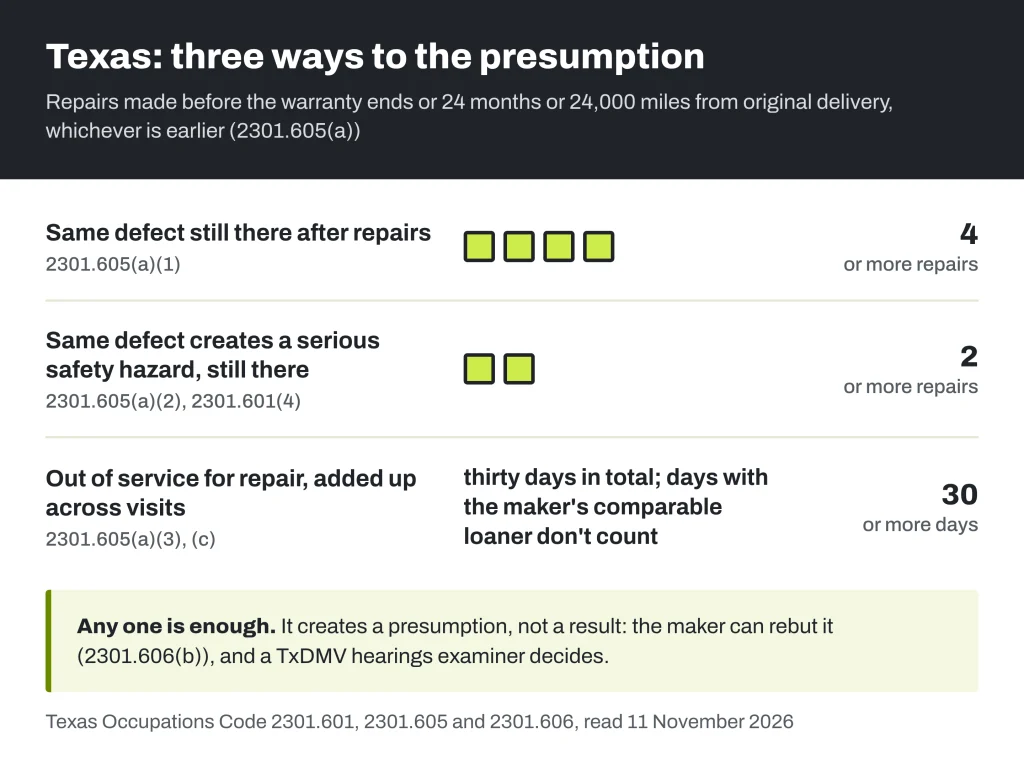
Three details sit further down the statute. The periods, days and miles are extended for any time repairs were not available “because of: (1) a war, invasion, or strike; or (2) a fire, flood, or other natural disaster” (2301.605(b)). The repairs named are those by the maker or “an authorized agent or franchised dealer”; on our reading, a visit to an independent shop is not one of the repairs the presumption counts. And the presumption is rebuttable: at the hearing the maker may plead that the defect “is the result of abuse, neglect, or unauthorized modification or alteration” or “does not substantially impair the use or market value” (2301.606(b)). TxDMV’s page says the mileage limits “generally do not apply” to towable RVs and other vehicles with no odometer.
Reaching a number is not a finding. The remedy itself, in 2301.604(a), turns on whether the maker could not fix a defect “that creates a serious safety hazard or substantially impairs the use or market value” after “a reasonable number of attempts”, and a TxDMV hearings examiner decides that. Our lemon checker lays Texas’s numbers next to your repair history and lists what it can’t check.
3. The steps that must come first
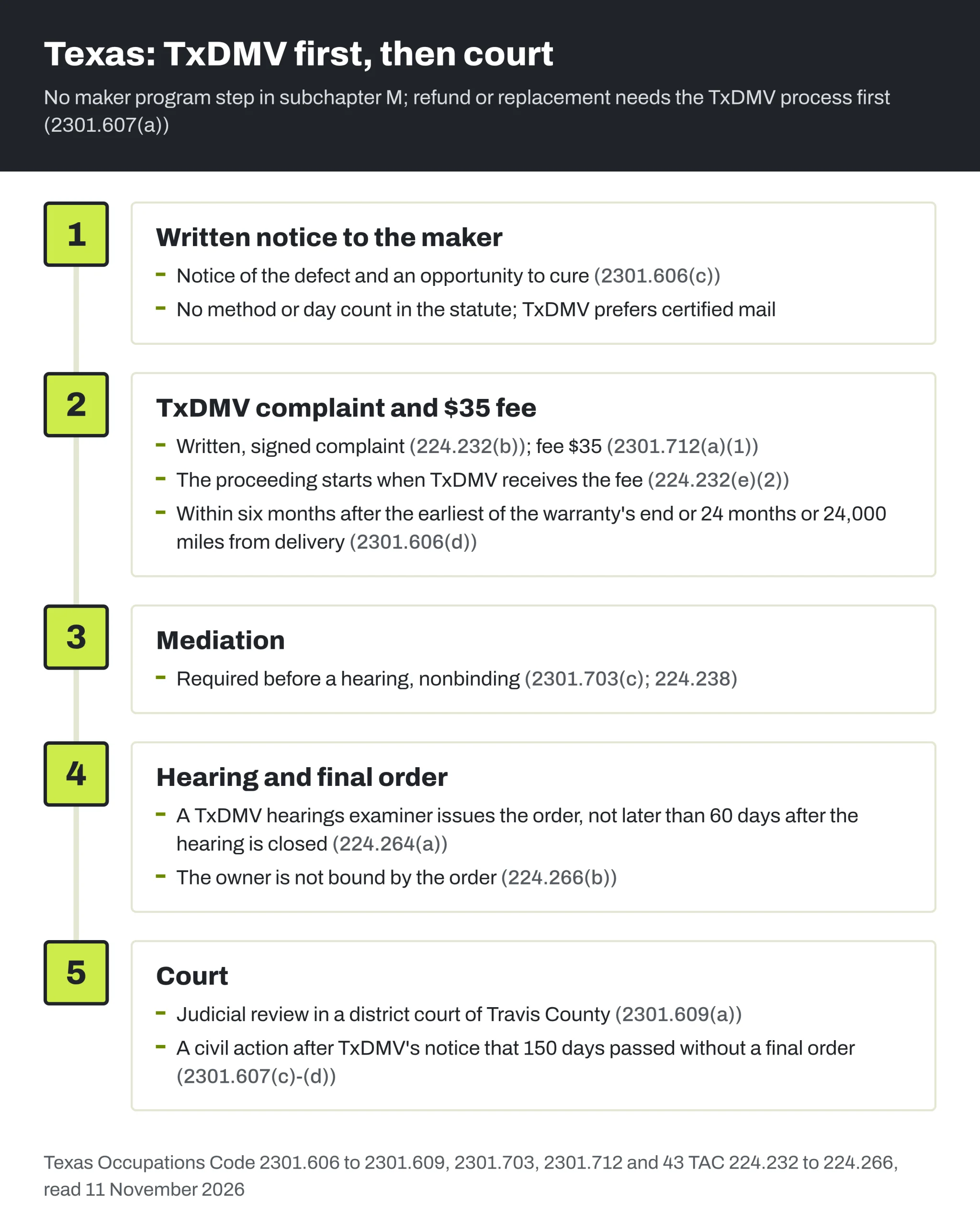
Written notice and a chance to cure. An order “may not require a manufacturer, converter, or distributor to make a refund or to replace a motor vehicle unless: (1) the owner, a person on behalf of the owner, or the department has provided written notice of the alleged defect or nonconformity to the manufacturer, converter, or distributor; and (2) the manufacturer, converter, or distributor has been given an opportunity to cure the alleged defect or nonconformity” (2301.606(c)). The notice goes to the maker, not only the dealer. The statute sets no method and no number of days. TxDMV’s page says to send it “preferably by certified mail” and links its own sample letter, which is addressed to the maker at the address in the warranty manual and asks for a repair within 30 days of receipt; those 30 days are the sample’s wording, not a period in the statute. The complaint must then give “the date the motor vehicle manufacturer, distributor, or converter first received written notice” (43 TAC 224.232(b)(2)(I)).
No maker program first. Some states make owners use the maker’s own dispute program before a state board or court (see lemon law arbitration). We found no such step in Texas’s subchapter M.
TxDMV, which is required. “A refund or replacement under this subchapter … is not available to the owner of the vehicle unless the owner has exhausted the administrative remedies provided by this subchapter” (2301.607(a)). In order:
- Complaint and fee. The complaint must be in writing and signed, and give the facts and the details listed in 43 TAC 224.232(b): mileage at purchase, at the first report and at filing; the dealer the problem was first reported to; each repair’s date and mileage, with repair orders where possible; and the date the maker first received written notice. It goes by mail or through TxDMV’s online complaint system (224.232(c)). The fee is “$35 for a complaint filed under Subchapter M” (2301.712(a)(1)). “A lemon law proceeding commences on the date the filing fee is received by the department” (224.232(e)(2)).
- Review. A TxDMV case advisor checks jurisdiction and the statute’s minimum requirements, then notifies the maker and asks for a response, and sends a copy to the selling dealer (224.234, 224.236).
- Mediation. The parties “must participate in mediation as provided by board rule before the parties may have a hearing” (2301.703(c)). The rule calls it “nonbinding mediation” by the case advisor, in good faith (224.238(a)-(b)).
- Hearing. If mediation fails, a TxDMV hearings examiner holds the hearing and “shall issue a final order” (2301.704(a-1), (c)), “not later than 60 days after the hearing is closed” (224.264(a)). TxDMV’s hearings office says the owner, who brings the complaint, has the burden of proof, the hearing is informal, held in or near the owner’s city, and parties need not have a lawyer; its rules generally require the vehicle to be brought for inspection and a test drive.
- After the order. “A complainant is not bound by a final order”; if the owner does not accept it, the complaint file is closed (224.266(b)-(c)). Either party may ask for a rehearing (2301.713; 224.264(b)), and a party affected by a final order may seek judicial review “under the substantial evidence rule in a district court of Travis County” (2301.609(a)). Both have short time limits. TxDMV’s hearings office says a motion for rehearing must be filed “not later than the 25th day after the date the decision and final order is signed”, that judicial review follows a denied motion, and that a petition for judicial review “must be filed not later than the 30th day after the date on which the decision became final and appealable”; an earlier date may apply.
4. The remedy and the use offset
A maker that cannot conform the vehicle to its warranty after a reasonable number of attempts “shall reimburse the owner for reasonable incidental costs resulting from loss of use” and either “(1) replace the motor vehicle with a comparable motor vehicle; or (2) accept return of the vehicle from the owner and refund to the owner the full purchase price, less a reasonable allowance for the owner’s use of the vehicle, and any other allowances or refunds payable to the owner” (2301.604(a)). The statute does not say who picks; the rule says the hearings examiner “will, to the extent possible, accommodate the complainant’s request with respect to replacement or repurchase” (43 TAC 224.260(a)(2)). Where the examiner finds the vehicle does not qualify for either, the order may require repairs instead (224.260(e)).
What the refund counts. “The purchase price shall be the total purchase price of the motor vehicle, excluding the amount of any interest, finance charge, or insurance premiums”, and the refund “shall include reimbursement of the amount of the lemon law complaint filing fee” (224.260(b)(1)). TxDMV’s page describes the price as “including taxes, title and license fee”. Where there is a loan, the refund is split between the owner and the lienholder by each one’s interest (2301.604(b)). Incidental costs must be “reasonable and verifiable” and include alternate transportation, towing, calls or mail to the maker or dealer about the vehicle, meals and lodging when it failed on an out-of-town trip, loss or damage to personal property, some attorney fees (below), and items or accessories added at or after purchase, less a reasonable allowance for use (224.262(a)). If a dealer-added item or option contributed to the defect, the order may make the dealer pay for that item (2301.608(b); 224.260(g)).
The use offset. The statute defines the “reasonable allowance for use” only as “the amount directly attributable to use of a motor vehicle when the vehicle is not out of service for repair” (2301.601(3)). The rule supplies the arithmetic. It presumes an expected useful life of 120,000 miles, a presumption either side can rebut “by a preponderance of the evidence”, and adds two parts (224.260(b)(2)):
- the total purchase price × the miles from delivery to “the first report of the defect or condition forming the basis of the repurchase order” ÷ 120,000; plus
- 50% of the total purchase price × the miles “after the first report … through the date of the hearing” ÷ 120,000.
Worked example (made-up numbers). Total purchase price $40,000. Odometer at delivery 10 miles, at the first report 8,010, at the hearing 20,010.
| Step | Working | Amount |
|---|---|---|
| Miles to the first report, full rate | $40,000 × 8,000 ÷ 120,000 | $2,666.67 |
| Miles from first report to hearing, half rate | 50% × $40,000 × 12,000 ÷ 120,000 | $2,000.00 |
| Use offset | $2,666.67 + $2,000.00 | $4,666.67 |
| Refund before incidental costs | $40,000 − $4,666.67 + $35 filing fee | $35,368.33 |
Two variants. For a towable RV (a travel trailer), the rule uses days, not miles: an expected life of “5,475 days or 15 years”, the same two parts counted in days of ownership, and “any day or part of a day that the vehicle is out of service for repair will be deducted from the numerator” (224.260(b)(3)). For a replacement instead of a refund, the new vehicle is priced at its sticker price (MSRP), the old one is credited at its MSRP when it was bought less the same use allowance, and the owner pays or finances that allowance, any loan still owed, and the taxes and fees on the new sale other than documentary fees (224.260(d)). Our buyback and refund estimator runs the Texas formula on your own numbers, and buyback, replacement or cash and keep explains what each kind of offer involves.
TxDMV first, then court: the 150-day rule
Section 2301.607 sets the order. “If a final order is not issued before the 151st day after the date a complaint is filed”, TxDMV must send the owner and the maker a certified-mail notice that the 150-day period has passed “and of the complainant’s right to file a civil action” (2301.607(c)). A person who receives that notice “may file a civil action against any person named in the complaint” (2301.607(d)), and a missing notice “does not affect a person’s right to bring an action” (2301.607(e)). Three details:
- The 150 days run from the start of the proceeding, which is the day TxDMV receives the $35 (224.232(e)(2)-(3)). Paying late “will delay the start of the 150-day period” and “may result in dismissal” (224.232(e)(1)).
- TxDMV “shall extend the 150-day period if a delay is requested or caused by the person who filed the complaint” (2301.607(c)). The notice also tells the owner of the right to continue the complaint at TxDMV (224.232(e)(3)).
- Against the maker in court, refund or replacement is “available in an action against a manufacturer, converter, or distributor brought under Chapter 17, Business & Commerce Code, after the owner has exhausted the administrative remedies”, but not in an action against the seller (2301.607(b)). We have not read chapter 17 for this page.
Subchapter M “does not limit a right or remedy otherwise available to an owner under another law” (2301.607(f)), such as a warranty claim under the federal Magnuson-Moss Warranty Act. And a contract term that “excludes or modifies a remedy provided by this subchapter is prohibited and is void as against public policy”, except in a settlement between the owner and the maker (2301.607(g)).
Who and what Texas covers
Vehicles. A “motor vehicle” includes any “fully self-propelled vehicle having two or more wheels” whose primary purpose is carrying people or property on a public highway, some titled off-road vehicles, “an engine, transmission, or rear axle” made for a vehicle over 16,000 pounds gross vehicle weight rating, and “a towable recreational vehicle” (2301.002(23)). A “new motor vehicle” is one “that has not been the subject of a retail sale regardless of the mileage” (2301.002(24)). We found no weight cap and no motorcycle exclusion. TxDMV’s page lists “cars, trucks, vans, motorcycles, all-terrain vehicles, motor homes, towable recreational vehicles (TRVs), and neighborhood electric vehicles”, says untitled demonstrators count as new, and says the law does not cover “repossessed vehicles, non-travel trailers, boats, or farm equipment”. Our RV and motorhome lemon laws page compares Texas with other states.
Owners. An “owner” is a person “entitled to enforce a manufacturer’s warranty” who “(A) purchased the motor vehicle at retail from a license holder; (B) is a lessor or lessee, other than a sublessee, who purchased or leased the vehicle from a license holder; (C) is a resident of this state and has registered the vehicle in this state; (D) purchased or leased the vehicle at retail and is an active duty member of the United States armed forces stationed in this state” when the proceeding starts, or (E) is a transferee or assignee of one of those who lives in Texas and registered the vehicle here (2301.601(2)). We found no personal-use test and no fleet-size limit in subchapter M, so the text does not exclude business buyers.
Leases. In a lease case “the final order may terminate the lease and apportion allowances or refunds, including the reasonable allowance for use, between the lessee and lessor” (2301.608(c)). Under the rule, the lessee gets back “all lease payments previously paid” and the sums paid to enter the lease (capitalized cost reduction, down payment, trade-in, sales tax, license, registration and documentary fees), less a use allowance worked out on the lessor’s price; the lessor gets its price plus “an additional 5.0% of the purchase price” and any fee paid to secure the lease, less a credit for the lessee’s payments; and “the lease shall be terminated without penalty to the lessee” (224.260(c)). More in lemon laws for leased cars.
The deadline to file with TxDMV
The rule in words: “A proceeding under this subchapter must be commenced not later than six months after the earliest of: (1) the expiration date of the express warranty term; or (2) the dates on which 24 months or 24,000 miles have passed since the date of original delivery of the motor vehicle to an owner” (2301.606(d)). Three things decide the date: when the warranty expires, when the vehicle turns 24 months from delivery, and when it reaches 24,000 miles from delivery. Whichever comes first starts the six months. The proceeding starts on the day TxDMV receives the filing fee (224.232(e)(2)), not the day the complaint is mailed. TxDMV’s page puts the second trigger as “24 months after purchase”; the statute counts from original delivery.
We found no pause of this six-month period in subchapter M; the extension in 2301.605(b) for a war, strike, fire or flood is written for the presumption’s periods, so on our reading it does not move the filing deadline. An earlier date may apply: a shorter warranty ends sooner, and the 24,000 miles can come well before 24 months. Our deadline rule lookup shows this rule in words for Texas and the other states; it does not work out a date.
For comparison only: Texas’s general period for breach of a sales contract, including a warranty, is “four years after the cause of action has accrued”, which the parties may shorten to not less than one year; a breach of warranty “occurs when tender of delivery is made”, unless the warranty explicitly extends to future performance (Business & Commerce Code 2.725, read 11 Nov 2026). Which period applies to a given lawsuit is for a court.
Attorney fees and costs in Texas
Subchapter M has no clause making the maker pay the owner’s lawyer. Two narrower rules exist. The owner who wins gets the $35 back: “the nonprevailing party in the case shall reimburse the amount of the filing fee” (2301.712(b)); otherwise the fee “is nonrefundable” (224.232(e)(1)). And the incidental costs a hearings examiner can order include “attorney fees if the complainant retains counsel after notification that the respondent is represented by counsel” (43 TAC 224.262(a)(6)). TxDMV’s hearings office says parties are not required to have a lawyer at a hearing.
Fee rules outside subchapter M, such as those for a federal warranty claim under 15 USC 2310(d)(2), where fees “may be allowed”, are covered in how lemon lawyers are paid, and who pays the fees. For a lawyer, the State Bar of Texas runs its own Lawyer Referral & Information Service; some metro counties have their own.
Used cars in Texas
Texas has no used-car lemon law. TxDMV’s page says “only new vehicles can qualify for a refund or replacement”. A used vehicle still under the maker’s original warranty may get repair-only help through a “warranty performance” complaint under 2301.204: it “must be made in writing to the applicable dealer, manufacturer, converter, or distributor and must specify each defect”, and “the owner may also invoke the board’s jurisdiction by sending a copy of the complaint to the board”. The rule allows filing if the defect “was reported to the manufacturer, distributor, or converter prior to the expiration of the warranty period”, and “a filing fee is not required” (43 TAC 224.232(f)). TxDMV notes this covers the maker’s original warranty, “not an extended service contract”.
Beyond that, the federal rules apply: the FTC’s Buyers Guide on the window of a dealer’s used car says whether it comes “as is” or with a warranty (see the used car Buyers Guide), and a dealer that sells a service contract within 90 days of the sale may not disclaim implied warranties (15 USC 2308(a)). The states that do have a used-car lemon law are on used-car lemon laws.
When a Texas buyback is sold again
A maker ordered to repurchase or replace a vehicle must issue, through its franchised dealer, a disclosure statement “stating that the vehicle was repurchased or replaced”, which “must accompany the vehicle through the first retail purchase” with TxDMV’s toll-free number for information about the defect. It must also “restore the cause of the repurchase or replacement to factory specifications and issue a new 12-month, 12,000-mile warranty on the vehicle” (2301.610). The rule adds a disclosure label in or on the vehicle that no holder of a TxDMV license or dealer number may remove before delivery to the first retail buyer (224.266(e)-(f)). TxDMV must publish an annual report of vehicles ordered repurchased or replaced, by brand and model (2301.611).
Claims about Texas lemon law, checked
You may see these on other sites. We checked them against the statute and the rule on 11 November 2026.
- “Three strikes and it’s a lemon.” Texas’s numbers are four repairs, two for a serious safety hazard, or 30 days (2301.605(a)), and they create a rebuttable presumption, not a result.
- “In Texas the maker pays your lawyer.” Subchapter M has no fee-shifting clause; the rule names attorney fees as an incidental cost where the owner hires counsel after being told the maker has counsel (224.262(a)(6)).
- “The offset only counts miles before the first repair.” Under 43 TAC 224.260(b)(2), miles after the first report count too, at half the rate, up to the hearing.
- “You can sue right away.” Refund or replacement under the lemon law needs the TxDMV process first (2301.607(a)); court comes after that, or after the 150-day notice (2301.607(c)-(d)).
- “The notice must go by certified mail.” The statute requires written notice to the maker and an opportunity to cure, without naming a method (2301.606(c)); certified mail is TxDMV’s preference.
Your next step in Texas
Keep every repair order, and check that each one records the date, the mileage in and out, the problem as you described it, and what was done; keep a log of the dates the vehicle was in the shop and of any loaner. TxDMV’s hearings office says the documents most often asked for are the sales contract or purchase order, an odometer statement, the warranty, the repair orders, letters with the maker, and the written notice. Then, in the order the statute sets:
- Find the maker’s address for notices in the warranty booklet, and read TxDMV’s sample notice letter (2301.606(c)).
- Read TxDMV’s lemon law page and its online complaint system, or call its Lemon Law Section at (888) 368-4689.
- Note the dates of the three deadline triggers for your vehicle: the warranty’s end, 24 months from delivery and 24,000 miles from delivery (2301.606(d)).
- Read the statute and TxDMV’s rules yourself; the sections above point to the lines that matter.
Texas’s row sits beside the other 50 on lemon laws in all 50 states and DC.
Fact-check note. Statutes and rules checked on 11 November 2026: Texas Occupations Code 2301.002, 2301.204, 2301.601-2301.613, 2301.703, 2301.704, 2301.712 and 2301.713, read in full in the official text (current through the 89th Legislature, 2nd Called Session, 2025); Business & Commerce Code 2.725; 43 TAC 224.232, 224.238, 224.260, 224.262, 224.264 and 224.266 in the Secretary of State’s current Texas Administrative Code, and the rest of 224.230-224.268 in TxDMV’s adoption document (effective 1 June 2024); TxDMV’s lemon law and hearings pages and sample letter, read the same day. We recheck state rules every three months and after each Texas legislative session. Found an error? See our corrections page.
Sources
- Texas Occupations Code ch. 2301, subch. M, 2301.601-2301.613, and 2301.204, 2301.703, 2301.704, 2301.712, 2301.713 (official text, current through the 89th Legislature, 2nd Called Session, 2025; read 11 Nov 2026)
- Texas Administrative Code, title 43, ch. 224, subch. G, 224.230-224.268 (eff. 1 June 2024, 49 TexReg 2771; 224.232, .238, .260, .262, .264, .266 read in the current TAC 11 Nov 2026)
- TxDMV: adoption of 43 TAC ch. 224, Exhibit A (4/11/24), text of subch. G (read 11 Nov 2026)
- TxDMV: Texas Lemon Law (read 11 Nov 2026)
- TxDMV: sample letter for written notification to manufacturer (read 11 Nov 2026)
- TxDMV: Office of Administrative Hearings, lemon law hearing procedures (read 11 Nov 2026)
- Texas Business & Commerce Code 2.725 (official text, read 11 Nov 2026)
- State Bar of Texas: Lawyer Referral & Information Service