A lemon law is a state law that makes a carmaker replace a new vehicle, or buy it back, when the maker cannot fix a serious defect covered by its warranty after a reasonable number of tries. Every state and the District of Columbia has one for new vehicles, and no two say exactly the same thing. Each one decides four things: how long the coverage window lasts, how many repair attempts or days in the shop count as “reasonable”, which steps must come first (written notice to the maker, the maker’s own dispute program, a state board), and what a buyback pays once a deduction for the miles you drove is taken off. A federal law, the Magnuson-Moss Warranty Act, sits underneath every state’s law but is not a lemon law for cars in the usual sense. This page opens our lemon law basics guide.
This page is general information, not legal advice and not a substitute for the advice of an attorney. Lemon laws, deadlines and required steps vary by state and change. The statute, the maker, a state board or a court decides a claim.
Below are the four deciding things with real numbers from the statutes, the federal law in plain words, who and what is covered (leases, motorcycles, motor homes, business use, used cars), what a lemon law does not do, and a short answer for each state we have a page on. Every rule below names its section and the date we read it in the official text: 11 November 2026.
The short version
- It’s state law. There is no national lemon law for cars, no national “three strikes” rule, no national buyback formula and no national deadline. Each state’s statute sets its own numbers.
- It covers defects the warranty covers. The defect has to be one the maker’s written warranty covers and serious enough to meet the state’s test: most of the statutes we read say it must “substantially” impair the vehicle’s use, value or safety, or some of those (New York names only value, 198-a(c)(1)); Virginia’s says “significantly impairs” (Va. Code 59.1-207.13(A)).
- Meeting the numbers creates a presumption, not a result. If the repairs or days in the shop reach the statute’s numbers inside the window, the law presumes the maker has had a reasonable number of attempts. The maker can still argue otherwise, and a board or court decides.
- Order matters. Many states require written notice to the maker, a final repair chance, the maker’s dispute program or a state board before a refund or a lawsuit.
- A buyback is rarely the full price. Most states deduct an allowance for your use of the car, usually figured from miles driven, though which miles count differs by state. Ohio’s law has no such deduction at all (Ohio Rev. Code 1345.72(B)).
The four things every state decides
Read any state’s lemon law and you will find the same four questions answered in different words. The terms first, in plain English. A nonconformity is the statute’s word for a defect or condition the warranty covers that the car doesn’t meet. A presumption is a rule that, once certain facts are shown, the law assumes something (here, that the maker has had enough chances to fix the car) unless the maker proves otherwise. Days out of service are days the car spends in the shop for repair of covered defects, counted as calendar days or business days depending on the state.
1. The coverage window
The window is the period in which the defect must first be reported, or the repair attempts made, for the law to apply. Some states call it the “lemon law rights period” or “term of protection”. It runs from the date the car was first delivered and usually ends at a time or mileage limit, whichever comes first. A few examples, as read on 11 November 2026:
| State | Window | Section |
|---|---|---|
| Illinois | 1 year or 12,000 miles, whichever is earlier | 815 ILCS 380/2(f) |
| Ohio | 1 year or 18,000 miles, whichever is earlier | Ohio Rev. Code 1345.72(A), 1345.73(A) |
| Virginia | 18 months from delivery, with no mileage limit | Va. Code 59.1-207.11 |
| New York | 2 years or 18,000 miles, whichever is earlier | N.Y. Gen. Bus. Law 198-a(b)(1) |
| Florida | 24 months from delivery | Fla. Stat. 681.102(9) |
| Texas | The warranty term or 24 months/24,000 miles, whichever is earlier | Tex. Occ. Code 2301.605(a) |
| Maine | The warranty term, 3 years or 18,000 miles, whichever comes first | 10 M.R.S. 1163(1), (3) |
Two details catch people. First, in many states the maker’s duty to repair a defect reported inside the window continues after the window closes: New York’s text says the repairs are owed “notwithstanding the fact that such repairs are made after the expiration” of the period (198-a(b)(1)), and Ohio’s says the same in its own words (1345.72(A)). Second, the window is not the deadline to file. The deadline is a separate rule, covered under “Deadlines to act” below.
2. The presumption: repairs and days in the shop
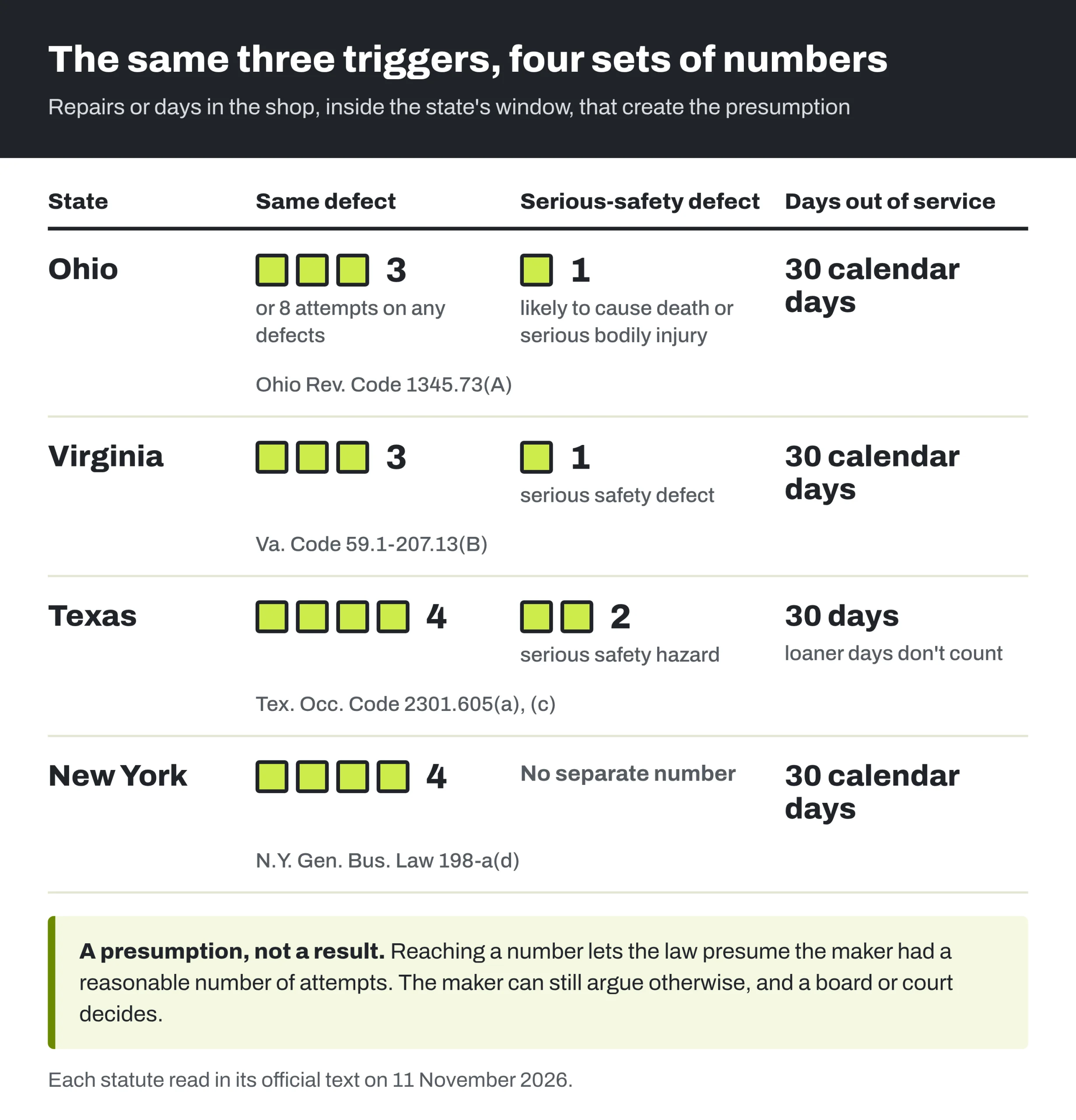
Most statutes don’t define “a reasonable number of attempts” in the abstract. They set numbers that, once reached inside the window, create the presumption. There are usually three kinds of trigger: repeated repairs of the same defect, fewer repairs of a defect that is dangerous, and a total number of days out of service. The numbers differ more than most summaries admit:
| State | Same defect | Serious-safety defect | Days out of service | Section |
|---|---|---|---|---|
| Ohio | 3 (or 8 attempts on any defects) | 1, for a defect “likely to cause death or serious bodily injury” | 30 calendar | Ohio Rev. Code 1345.73(A) |
| Virginia | 3 | 1, for a “serious safety defect” | 30 calendar | Va. Code 59.1-207.13(B) |
| Texas | 4 | 2, for a “serious safety hazard” | 30 (loaner days don’t count; the statute says only “days”) | Tex. Occ. Code 2301.605(a), (c) |
| Washington | 4 diagnosis or repair attempts | 2, for a “serious safety defect” | 30 calendar, at least 15 during the warranty | RCW 19.118.041(2); motor homes have their own rule |
| New York | 4 | No separate number | 30 calendar | N.Y. Gen. Bus. Law 198-a(d) |
| Maryland | 4 | 1, for brake or steering failure, after notice, if the car still fails Maryland’s safety inspection | 30 (the statute says only “days”) | Md. Com. Law 14-1502(d) |
| Massachusetts | 3 | No separate number | 15 business, then one final chance of up to 7 business days | Mass. G.L. c. 90 s. 7N1/2 |
| Louisiana | 4 | No separate number | 45 calendar | La. R.S. 51:1944(A) |
Three things sit behind those numbers. The repairs usually have to be of the same defect (“substantially the same nonconformity” in Ohio). Some states count only attempts made within the window. And a few add a step after the count is reached: Florida requires written notice and a final repair attempt by the maker after three tries (Fla. Stat. 681.104(1)(a)), and Massachusetts gives the maker one more chance of up to seven business days (c. 90 s. 7N1/2).
3. The steps that must come first
This is where claims are most often lost, because the steps are easy to skip and differ so much. There are three kinds:
- Written notice to the maker, sometimes by a set method. Florida names “registered or express mail” to the maker (681.104(1)(a)); Maryland, “certified mail, return receipt requested” during the warranty period, with the maker then having 30 days from receipt to correct the defect (Md. Com. Law 14-1502(b)). Some tie the notice step to what the maker told you: California’s direct-notice step for the repair counts applies only if the warranty or owner’s manual clearly and conspicuously discloses it (Cal. Civ. Code 1793.22(b)). Virginia makes the maker disclose “clearly and conspicuously”, in the warranty or owner’s manual, that written notification is required, and gives a maker that was not notified one more chance of up to 15 days to repair (59.1-207.13(D), (E)).
- The maker’s own dispute program. Many states, and federal law, let the maker require you to use its informal dispute program (often run by an outside body) before going to court, provided the program meets the Federal Trade Commission’s rules in 16 CFR 703. Federal rules make such programs free to consumers (16 CFR 703.3(a)) and say their decisions do not legally bind anyone (703.5(j)). Some states let you choose instead: Maryland’s statute says a consumer “may resort” to the maker’s program and can still seek other remedies (14-1502(i)).
- A state board or agency. Some states run their own program and make it a required step. In Texas, a refund or replacement is ordered through the Texas Department of Motor Vehicles process; no such order can be made unless the maker got written notice of the defect and a chance to cure it (Tex. Occ. Code 2301.606(c)), and the complaint must be filed within six months after the earliest of the warranty’s end or 24 months or 24,000 miles from delivery (2301.606(d)). In Florida, the dispute must first go to the state, and to its arbitration board if eligible, before court (Fla. Stat. 681.1095(4)). New York lets the consumer choose the state’s arbitration on payment of a “prescribed filing fee” (198-a(k)).
How each program works, what it costs and whether its decision binds you: lemon law arbitration, maker programs and state boards. The steps in order, state by state: how to file a lemon law claim.
4. The remedy and the use offset
If the presumption holds and the steps were followed, the maker must either replace the vehicle with a comparable one or repurchase it (a “buyback”) and refund the price. Who chooses differs: in New York the choice is “at the option of the consumer” (198-a(c)(1)); Virginia gives the consumer “the unconditional right to choose a refund rather than a replacement” (59.1-207.13(A)). What the refund includes differs too: New York adds license fees, registration fees and similar government charges (198-a(c)(1)); Ohio adds incidental damages such as towing, rental, meals and lodging (1345.72(B)).
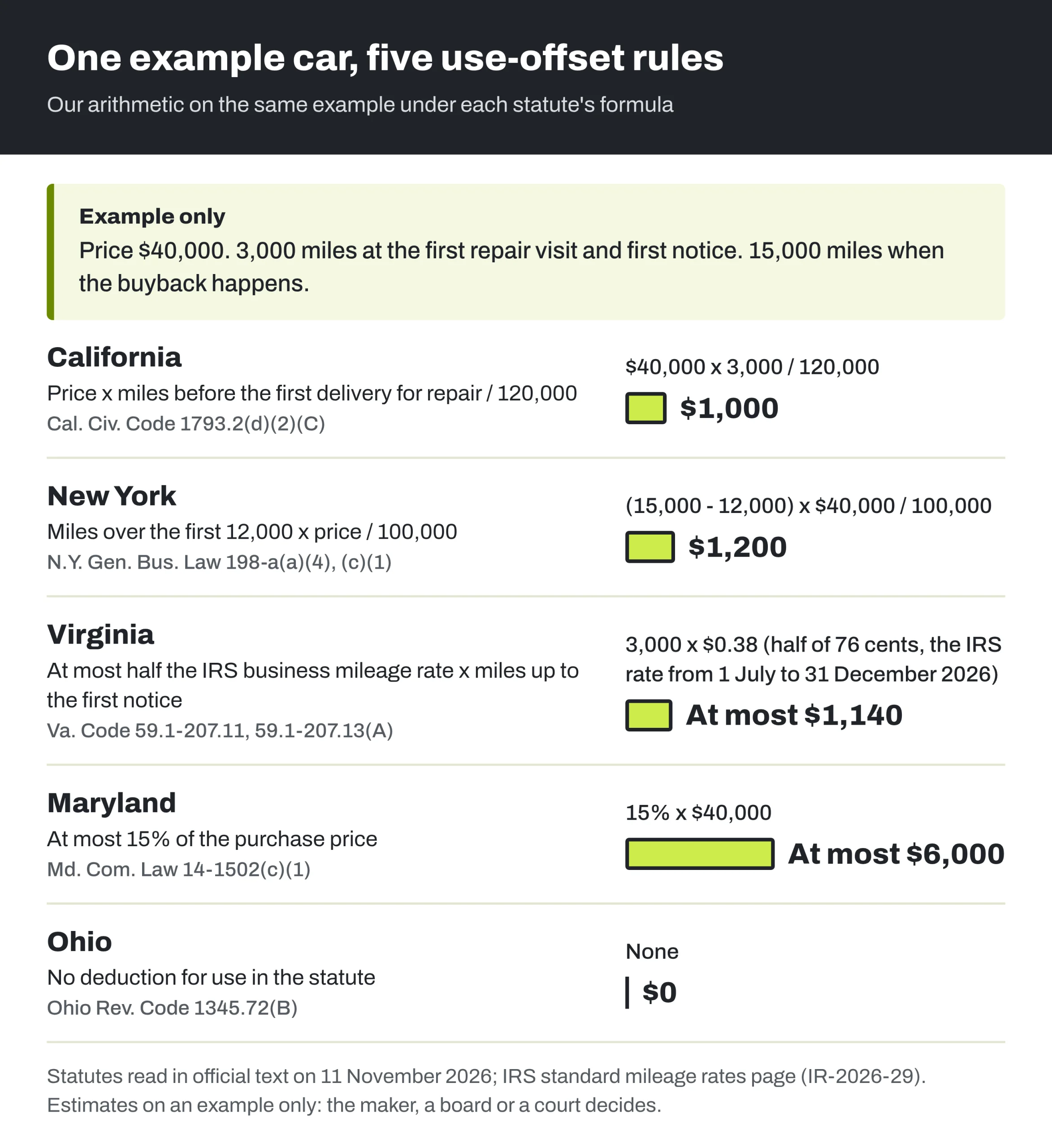
Most states then take off a use offset (also called a reasonable allowance for use): a deduction for the miles you drove. The formulas fall into a few families. Here is one example car worked through five of them. Example only: price $40,000; 3,000 miles on the odometer at the first repair visit and first notice; 15,000 miles when the buyback happens.
| State and rule | The arithmetic on the example | Offset |
|---|---|---|
| California: price x miles before the first delivery for repair / 120,000 (Cal. Civ. Code 1793.2(d)(2)(C)) | $40,000 x 3,000 / 120,000 | $1,000 |
| New York: miles over the first 12,000 x price / 100,000 (N.Y. Gen. Bus. Law 198-a(a)(4), (c)(1)) | (15,000 – 12,000) x $40,000 / 100,000 | $1,200 |
| Virginia: at most half the IRS business mileage rate x miles up to the first notice (Va. Code 59.1-207.11, 59.1-207.13(A)) | 3,000 x $0.38 (half of 76 cents, the IRS rate from 1 July to 31 December 2026; the statute doesn’t say which date’s rate applies) | At most $1,140 |
| Maryland: at most 15% of the purchase price (Md. Com. Law 14-1502(c)(1)) | 15% x $40,000 | At most $6,000 |
| Ohio: no deduction for use in the statute (Ohio Rev. Code 1345.72(B)) | None | $0 |
Which price the formula uses, which miles it counts and what else comes off (damage beyond normal wear, in New York, Maryland and Virginia) all vary. Several states give no formula at all, only the words “reasonable allowance”, and leave the number to the parties or a court. The buyback and refund estimator applies your state’s own formula to your numbers and shows each line, and buyback, replacement or cash and keep explains what each offer involves.
Deadlines to act
Each state sets its own deadline to file a lawsuit or a program claim, and they are measured from different starting points. Examples, as rules in words: in Ohio, a suit within five years of the original delivery, with the time paused while a complaint is before a qualified dispute program (1345.75(C)); in New York, within four years of the original delivery (198-a(j)); in Maryland, within three years of the original delivery (14-1502(k)); in Texas, a complaint to the state within six months after the earliest of the warranty’s end or 24 months or 24,000 miles (2301.606(d)). Some states’ lemon laws set no deadline of their own, and then a general limit for contract or warranty claims probably applies, which we have not read for every state. An earlier date may apply to you, for example because of a step in a maker’s program or your contract. The lemon law deadline lookup shows each state’s rule in words with its section; it does not compute a date.
The federal law: Magnuson-Moss
The Magnuson-Moss Warranty Act (15 U.S.C. 2301-2312, read in the US Code 2024 edition on govinfo on 11 November 2026) applies in every state. It’s often called “the federal lemon law”, which is misleading for cars. What it does:
- Full or limited. A written warranty on a product costing more than $10 must be labelled either a “full (statement of duration) warranty” or a “limited warranty” (15 U.S.C. 2303(a), (d)). New-car warranties are almost always labelled limited; check the booklet for your car.
- The refund-or-replace right is only for full warranties. Under a full warranty, if a defect remains “after a reasonable number of attempts” to fix it, the maker “must permit the consumer to elect either a refund for, or replacement without charge of,” the product (2304(a)(4)). A limited warranty doesn’t carry that duty.
- So for most cars, the federal route is a suit for damages. A consumer harmed by a maker’s failure to honor a written or implied warranty “may bring suit for damages and other legal and equitable relief” (2310(d)(1)), after giving the maker “a reasonable opportunity to cure” (2310(e)). Federal court is open only if at least $50,000 is in controversy (2310(d)(3)); otherwise the suit goes to state court.
- Programs first, if the warranty says so. If the maker’s dispute program meets the FTC’s rules and the warranty requires it, the consumer must use it before suing under the Act (2310(a)(3)).
- Fees “may be allowed”. A consumer who “finally prevails” may be allowed costs and expenses, including attorneys’ fees, unless the court finds an award “inappropriate” (2310(d)(2)). That is a may, not a must.
- Later owners count. A person to whom the car is transferred during the warranty is a “consumer” under the Act (2301(3)).
- State law stays. “Nothing in this chapter shall invalidate or restrict any right or remedy of any consumer under State law” (2311(b)(1)). And the Act sets no deadline of its own to sue.
More, with the FTC’s rules on warranty programs: the Magnuson-Moss Warranty Act. If the dealer is the problem rather than the maker: when a dealer won’t fix your car.
Who and what is covered
State laws are written for new vehicles bought or leased mainly for personal use, but the edges differ.
Personal and business use
New York covers a vehicle “used primarily for personal, family or household purposes” (198-a(a)(1)). Minnesota sets a share: personal use “at least 40 percent of the time” (Minn. Stat. 325F.665, subd. 1(b)). Maryland excludes “a fleet purchase of five or more motor vehicles” (14-1502(m)). Louisiana excludes vehicles “used exclusively for commercial purposes” and those of 10,000 GVW or above (La. R.S. 51:1941(6)). Your state’s page gives its own rule.
Leased cars
Most of the statutes we read include lessees, often with conditions. Florida covers a lessee who leases “for 1 year or more” under a written lease (Fla. Stat. 681.102(10)); New York’s lessee is one whose written lease makes the lessee “responsible for repairs” (198-a(a)(5)); Virginia ends the lease “without penalty to the consumer” on a refund or replacement (59.1-207.13(A1)). How the refund is split between you and the leasing company: lemon laws for leased cars.
Motorcycles
There is no national answer. Massachusetts covers motorcycles and gives them their own offset divisor of 25,000 (c. 90 s. 7N1/2); New Jersey’s definition of motor vehicle includes motorcycles (N.J.S.A. 56:12-30); Pennsylvania added motorcycles through Act 151 of 2024. Florida’s law excludes “motorcycles, mopeds” (Fla. Stat. 681.102(14)), and Missouri’s definition of new motor vehicle excludes motorcycles (Mo. Rev. Stat. 407.560(6), in force since 28 August 2021; the version before it excluded them too).
Motor homes and RVs
Many states cover the drivable part of a motor home but not its living quarters. Florida includes recreational vehicles but not their “living facilities”, and gives them longer numbers: 60 days out of service instead of 30 (681.104(3)) and a 60,000-mile divisor in the offset instead of 120,000 (681.102(19)). Missouri covers only the “chassis, engine, powertrain and component parts” of recreational motor vehicles (407.560(6)). State by state: RV and motorhome lemon laws.
Second owners during the warranty
Many state laws, like the federal Act, cover a person the car is transferred to while the warranty is still running. Louisiana’s definition of consumer includes “a person … to whom a motor vehicle is transferred during the duration of an express warranty” (51:1941(2)(b)), and Maryland’s rights “inure to a subsequent transferee … for the duration of the applicable warranties” (14-1502(j)(2)).
Used cars
Most lemon laws are for new vehicles, but a used car is not always on its own. Twelve of the states we read have a separate used-car law for dealers, usually a short dealer warranty or a limit on selling “as is”, and a few others limit “as is” sales in their general sales laws. The twelve: Arizona (A.R.S. 44-1267), Connecticut (C.G.S. ch. 743f), Hawaii (H.R.S. ch. 481J), Illinois (815 ILCS 505/2L), Maine (10 M.R.S. 1474), Massachusetts (G.L. c. 90 s. 7N1/4), Minnesota (Minn. Stat. 325F.662), New Jersey (N.J.S.A. 56:8-67 and following), New Mexico (N.M. Stat. 57-16A-3.1), New York (Gen. Bus. Law 198-b), Rhode Island (R.I. Gen. Laws ch. 31-5.4) and West Virginia (W. Va. Code 46A-6-107a). What each requires: used-car lemon laws.
Two federal rules apply everywhere. A dealer’s window sticker, the FTC Buyers Guide, becomes part of the sale contract and overrides contrary terms in it (16 CFR 455.3(b)). And a seller that sells you a service contract at the time of sale or within 90 days can’t disclaim implied warranties (15 U.S.C. 2308(a)). More: buying “as is” and the Buyers Guide.
Lawyers and fees
Many owners use a lawyer for a lemon law claim, and many lemon laws let a winning consumer recover attorney’s fees from the maker, but the wording ranges widely. Ohio says a consumer “shall be entitled to recover reasonable attorney’s fees and all court costs” (1345.75(A)); Maryland says a court “may award” them to a prevailing plaintiff, and if an action is brought in bad faith or is frivolous, the court “may order the offending party to pay” the other side’s fees (14-1502(l)); Texas’s lemon law has no fee clause at all. Who pays in each state: how lemon lawyers are paid, and who pays the fees.
What a lemon law does not do
- It doesn’t decide your case. Reaching the numbers creates a presumption; the maker may still defend. Several statutes name the defenses: that the defect does not substantially impair the vehicle (Tex. Occ. Code 2301.606(b); Md. Com. Law 14-1502(c)(3); N.Y. Gen. Bus. Law 198-a(c)(3)), or that it is the result of abuse, neglect, or unauthorized modification or alteration (those three, and Ohio Rev. Code 1345.75(D)).
- It doesn’t cover everything that breaks. Wear items, damage and anything outside the warranty fall outside it. For a denied warranty repair: what the law lets you do when a warranty claim is denied.
- It isn’t a recall law. A recall is a separate federal duty to fix a safety defect for free (49 U.S.C. 30120). Whether recall repairs count as lemon-law repair attempts varies by state, and we have not read every state’s rule on it. See recall rights.
- It doesn’t cover crash injuries or the car’s lost value after a crash. Those are separate claims, outside this site.
- It doesn’t make a service contract a warranty. An “extended warranty” is a service contract in federal law (15 U.S.C. 2301(8)); lemon laws turn on the maker’s warranty.
Claims you may see elsewhere
You may see these on other sites. We checked each against the statute, and it isn’t what the text says.
- “A car is a lemon after three repair attempts.” The count differs by state: one attempt on a defect likely to cause death or serious bodily injury in Ohio (1345.73(A)(4)), two on a serious safety hazard in Texas (2301.605(a)(2)), three in Virginia, four in New York, Texas and Maryland, and some states add a final repair after written notice.
- “Magnuson-Moss gives every car owner a refund.” The refund-or-replace duty in 15 U.S.C. 2304(a)(4) applies to full warranties; car warranties are usually limited.
- “Louisiana gives the maker 90 days.” Its statute says 45 calendar days out of service (La. R.S. 51:1944(A), read 11 November 2026).
- “The maker always pays the lawyer.” Texas’s lemon law has no fee clause, and under the federal Act fees only “may be allowed” (2310(d)(2)).
Your state, in short
Each state page quotes the statute on all four things, with the deadline rule, fees, leases and used cars. The table below gives the short answer for the states we have pages on; every other state is in the lemon laws by state section and its 51-row table. All rows read in the official text on 11 November 2026 unless the row says otherwise.
| State | Window | Presumption (same defect / safety / days) | What comes first |
|---|---|---|---|
| Arizona (A.R.S. 44-1261 to -1265) | Shorter of the warranty or 2 years/24,000 miles | 4 / none / 30 calendar | Prior direct written notice and a chance to cure; a complying maker program |
| California (Civ. Code 1793.22; CCP 871.20-871.30) | 18 months or 18,000 miles, earlier | 4 / 2 (likely to cause death or serious bodily injury) / more than 30 calendar | Direct notice to the maker once, if the warranty or manual clearly discloses it; a qualified maker program if you got timely written notice of it; makers on the state’s opt-in list: written notice at least 30 days before suing for civil penalties |
| Florida (Fla. Stat. 681.10-681.118) | 24 months from delivery | 3 plus a final attempt / none / 30 (RV 60) | Notice by registered or express mail; the maker’s certified procedure if any, then the state board |
| Georgia (O.C.G.A. 10-1-780 to -798, AG-posted text current through 2024) | 24 months or 24,000 miles, earlier | 3 / 1 / 30 calendar | Certified mail or statutory overnight delivery; an AG-certified maker program if any, then state arbitration before suing |
| Illinois (815 ILCS 380) | 1 year or 12,000 miles, earlier | 4 / none / 30 business | Prior direct written notice; a maker program if you were told of it in writing |
| Indiana (IC 24-5-13, official 2026 Indiana Code file as archived 3 Aug 2026) | Defect reported within 18 months or 18,000 miles, earlier | 4 / none / 30 business | Written notice if the warranty or manual says so; an AG-certified program if you were told of it |
| Massachusetts (G.L. c. 90 s. 7N1/2) | 1 year or 15,000 miles, earlier | 3 / none / 15 business, then a final chance | State arbitration available, asked for within 18 months of delivery |
| Missouri (RSMo 407.560-.579) | Earlier of the warranty or 1 year | 4 / none / 30 working | Written notice to the maker; the maker’s program first |
| New Jersey (N.J.S.A. 56:12-29 and following) | 2 years or 24,000 miles, earlier | 3 / 1 / 20 calendar (motor home 45) | Certified mail, return receipt, and one repair chance within 10 calendar days |
| New York (Gen. Bus. Law 198-a) | 2 years or 18,000 miles, earlier | 4 / none / 30 calendar | Report in the period; the maker’s program if any, or the state’s arbitration |
| North Carolina (G.S. 20-351 to 20-351.11) | 24 months or 24,000 miles | 4 / none / 20 business in any 12 months of the warranty | Direct written notice and up to 15 days for a final repair, if the warranty or manual discloses it; 10 days’ written notice before suing |
| Ohio (Rev. Code 1345.71-.78) | 1 year or 18,000 miles, earlier | 3 (or 8 on any defects) / 1 / 30 calendar | Report the defect; a qualified maker program if you were told in writing |
| Pennsylvania (73 P.S. 1951-1963) | Earliest of 1 year, 12,000 miles or the warranty | 3 / none / 30 calendar | The maker’s program first; its decision doesn’t bind the buyer |
| Texas (Occ. Code 2301.601-.613) | Earlier of the warranty or 24 months/24,000 miles | 4 / 2 / 30 days | Written notice and a chance to cure; a TxDMV complaint within 6 months after the earliest of the warranty’s end, 24 months or 24,000 miles |
| Virginia (Va. Code 59.1-207.9 to -207.16:1) | 18 months, no mileage limit | 3 / 1 / 30 calendar | Notice to the maker (the warranty or manual must say written notice is required); a maker not notified gets up to 15 more days; a maker program is optional |
| Washington (RCW 19.118) | 2 years or 24,000 miles, earlier | 4 / 2 / 30 calendar (15 under the warranty) | Written request to the maker; the state board or the maker’s program before suing |
We read 44 of the 51 laws in current official text. Four more (Arkansas, Georgia, Indiana and Mississippi) we could read only in an older or agency-posted copy, and Wisconsin’s only through its transportation department’s own pages. The statutes of New Hampshire (RSA 357-D) and Tennessee (Tenn. Code 55-24-101 and following) would not open for us, so we state none of their rules; New Hampshire’s DMV describes a New Motor Vehicle Arbitration Board on its own pages. The 51-state table marks those rows “not confirmed” and links the state agency.
What to do next
- Keep every repair order. For each visit: the date in and out, the mileage, the complaint as the shop wrote it, what was done, and the days the car was out of service. Ask for a written order even when the shop finds “no problem”. Most of the numbers above are counted from these papers.
- Read your warranty booklet and owner’s manual for two things: whether written notice to the maker is required and where it goes, and whether the maker names a dispute program you must use first.
- Find your state’s rule. Open your state’s page or the 51-state table, which links the official statute and the state agency, and check the deadline rule in words.
- Line up your history with the numbers in the lemon checker, and see what an offset might look like in the estimator. Both show your state’s section and read date and say what they cannot check.
Official texts used on this page: 15 U.S.C. 2310 on govinfo (and 2301, 2303, 2304, 2308, 2311), 16 CFR 703 on the eCFR, New York Gen. Bus. Law 198-a, Ohio Rev. Code 1345.73, Texas Occ. Code ch. 2301, Florida Stat. ch. 681, Virginia Code ch. 17.3, Maryland Com. Law 14-1502 and the IRS standard mileage rates.
Fact-check note. Statutes and rules checked on 11 November 2026: 15 U.S.C. 2301-2312 (US Code 2024 edition, govinfo); 16 CFR 455 and 703 (eCFR, up to date as of 9 November 2026); New York Gen. Bus. Law 198-a (NY Senate site, most recent revision 22 September 2014); Ohio Rev. Code 1345.72, 1345.73 and 1345.75 (codes.ohio.gov); Texas Occ. Code 2301.604-2301.606 (current through the 89th Legislature, 2nd Called Session, 2025); The 2026 Florida Statutes, ch. 681; Virginia Code 59.1-207.11 and 59.1-207.13; Maryland Com. Law 14-1502; 2026 Minnesota Statutes 325F.665; Mo. Rev. Stat. 407.560 (version effective 28 August 2021, and the version before it); RCW 19.118; Mass. G.L. c. 90 s. 7N1/2; La. R.S. 51:1941 and 51:1944; 815 ILCS 380/2 and 380/3 (Illinois’s official ftp.ilga.gov copy); 10 M.R.S. 1163; the IRS standard mileage rates page (last updated 28 July 2026). The other state rows come from our same-day reads of each state’s official text, listed on each state page. Lemon laws change: we recheck state rows every three months and after each legislative session.
Sources
- 15 U.S.C. 2301-2312, Magnuson-Moss Warranty Act (US Code 2024 edition, govinfo)
- 15 U.S.C. 2304, federal minimum standards for warranties (govinfo)
- 15 U.S.C. 2303, full and limited warranty labels (govinfo)
- 15 U.S.C. 2301, definitions (govinfo)
- 15 U.S.C. 2308, implied warranties (govinfo)
- 15 U.S.C. 2311, applicability to other laws (govinfo)
- 16 CFR part 703, informal dispute settlement procedures (eCFR, up to date as of 9 Nov 2026)
- 16 CFR part 455, Used Motor Vehicle Trade Regulation Rule (eCFR)
- 49 U.S.C. 30120, recall remedies (govinfo)
- New York General Business Law 198-a (NY Senate)
- Ohio Revised Code 1345.72 (codes.ohio.gov)
- Ohio Revised Code 1345.73 (codes.ohio.gov)
- Ohio Revised Code 1345.75 (codes.ohio.gov)
- Texas Occupations Code chapter 2301 (Texas Legislature)
- The 2026 Florida Statutes, chapter 681 (Florida Legislature)
- Code of Virginia, title 59.1 chapter 17.3, Motor Vehicle Warranty Enforcement Act
- Maryland Commercial Law 14-1502 (Maryland General Assembly)
- 2026 Minnesota Statutes 325F.665 (Revisor of Statutes)
- RCW 19.118, motor vehicle warranties (Washington Legislature)
- Massachusetts General Laws c. 90 s. 7N1/2 (Massachusetts Legislature)
- Louisiana R.S. 51:1941 (Louisiana Legislature)
- Louisiana R.S. 51:1944, replacement or refund (Louisiana Legislature)
- Missouri Revised Statutes 407.560 (Revisor of Statutes)
- Maine 10 M.R.S. 1163 (Maine Legislature)
- California Civil Code 1793.2 (California Legislative Information)
- IRS standard mileage rates (last updated 28 Jul 2026)
- Illinois 815 ILCS 380, New Vehicle Buyer Protection Act (Illinois General Assembly)
- North Carolina G.S. Chapter 20, Article 15A (NC General Assembly)
- Arizona Revised Statutes 44-1261 to 44-1267 (Arizona Legislature)